
Applying for a police officer mortgage in the UK should be straightforward. You have a stable, permanent public-sector job, a defined-benefit pension, and a career that most lenders publicly say they respect. And yet thousands of officers hit the same wall: their payslips confuse underwriters, their pension contributions shrink their apparent take-home, and their shift allowances get cut in half by a lender who has never dealt with police pay before. This guide explains exactly how lenders assess your income, what they do with your pension deductions, and how to make sure none of your legitimate earnings are left on the table.
Table of Contents
- Quick Takeaways
- Why Police Officer Mortgages Are Different
- How Lenders Assess Shift Pay and Overtime
- The Pension Deduction Problem
- Income Multiples and How Much You Can Borrow
- Key Worker Schemes Available to Police Officers
- How Lenders Compare on Police Applications
- What Documents You Need
- Frequently Asked Questions
- References
Quick Takeaways
| Key Insight | Explanation |
|---|---|
| Shift pay is treated inconsistently | Some lenders count 100% of regular shift allowances; others apply a 50% haircut. The lender you pick matters enormously. |
| Pension contributions reduce apparent take-home, not your mortgage eligibility | Police pension contributions are compulsory and large. A specialist lender adds them back when calculating affordability; a standard lender may not. |
| Overtime requires evidence of consistency | Most lenders want at least six months of payslips showing regular overtime before they will count any of it toward your borrowing capacity. |
| Income multiples can reach up to 6x for officers | Specialist and professional lenders can offer up to five to six times income in some cases, compared to the standard 4.5x offered by high-street banks. |
| Do not opt out of your pension to boost your mortgage | Opting out of the 2015 CARE scheme for even one year can represent a significant long-term actuarial loss far greater than any short-term borrowing gain. |
| London Weighting counts as basic salary | London Weighting and London Allowance are permanent, pensionable, and treated as guaranteed income by most police-aware lenders. |
| A specialist broker saves time and protects your credit file | Applying to the wrong lender leaves footprints on your credit file. A broker who handles police applications routes you to the right one first time. |
Why Police Officer Mortgages Are Different
Police officers are not unusual borrowers in the way that freelancers or CIS contractors are. Your employment is permanent, your contract is clear, and your income is deposited reliably each month. The complication is structural: police pay is built from multiple components that a standard mortgage underwriter may not know how to read.
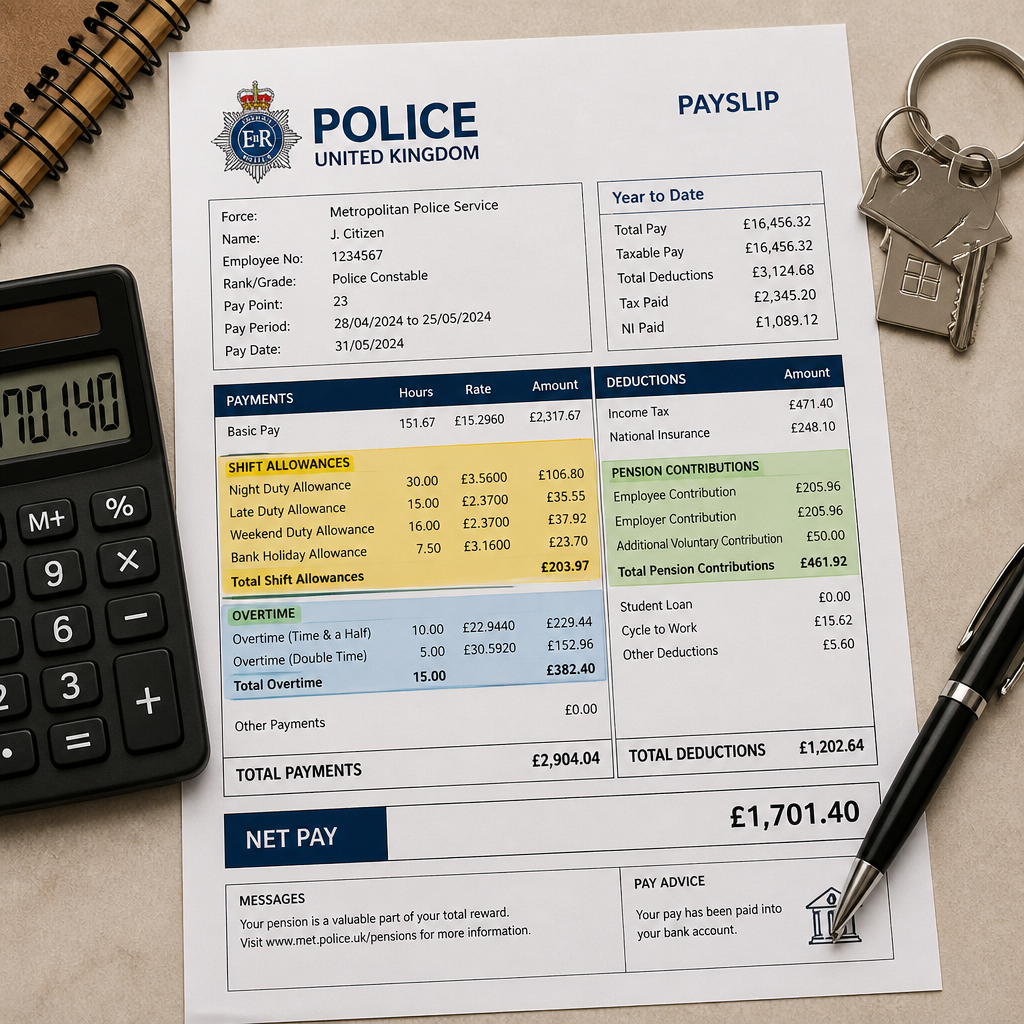
A typical officer’s payslip might include basic salary, shift disturbance allowance, unsocial hours payment, overtime, London Weighting, Special Priority Payments, and a substantial pension deduction that can represent 13% or more of gross pay. When a high-street lender looks at take-home pay rather than gross earnings, the borrowing figure can look far smaller than it actually should be.
The good news is that lenders who regularly handle police applications understand this structure. The challenge is finding them, and avoiding the lenders who will waste your time and leave a search footprint on your credit file in the process.
How Lenders Assess Shift Pay and Overtime
This is the section most officers need to read carefully. Variable pay is the single biggest point of difference between lenders, and the gap between a generous and a restrictive lender can add or remove tens of thousands of pounds from your borrowing limit.
Fixed shift allowances vs. variable shift payments
Some components of police pay are fixed and contractual. Shift disturbance allowance, for example, is paid at a set rate for working irregular hours and does not depend on how many unsocial shifts you actually worked that month. Lenders who understand police pay treat these as part of basic salary, counting them at 100%.
Other payments, such as unsocial hours supplements or irregular shift bonuses, vary month to month depending on your rota. These are treated more like overtime by cautious lenders, who may apply a 50% discount or ask for extended payslip evidence before counting them.
How overtime is treated in practice
Overtime is the most variable element of police income and lenders apply very different rules to it. Some lenders ignore overtime entirely. Others count 50% of an average, while specialist lenders may count 100% if the overtime is regular and evidenced. What most lenders agree on is that you need to demonstrate consistency: typically six months of payslips showing steady overtime before a lender will include it in their calculation.
Pro tip: Before you apply, gather 12 months of payslips rather than the minimum three. The longer your documented history of consistent shift pay and overtime, the stronger your case with any lender, and the more options a broker has to negotiate on your behalf.
Allowances like London Weighting sit in a separate category. Because they are permanent, contractual, and pensionable additions to basic salary, most police-aware underwriters treat them as guaranteed income at full value, directly increasing your gross annual earnings and therefore your borrowing multiple.
Second jobs and additional income sources
Some officers take on secondary employment or receive income from renting a property. Most lenders require at least six months in a second role before counting that income. If you receive maintenance payments or other regular personal income, lenders typically want three months of bank statements demonstrating consistent receipt before factoring it into affordability.
The Pension Deduction Problem
Police pension contributions are compulsory, substantial, and one of the most valuable financial assets you will ever hold. They are also, through no fault of yours, a regular source of mortgage complications.
Under the 2015 Police Pension Scheme (CARE), officers accrue pension benefits based on career average revalued earnings. Contribution rates are linked to salary band and are not optional. A constable earning a mid-range salary can find a significant share of their gross pay going into the pension each month, reducing take-home pay to a level that, on paper, looks tight relative to borrowing costs.
A lender unfamiliar with police pay may take your net take-home figure and apply a standard debt-to-income assessment. The result is a deflated borrowing limit that does not reflect your real financial position. A specialist lender recognises that pension contributions are compulsory deductions, not discretionary spending, and adjusts their affordability calculation accordingly.
Opting out of the police pension to boost take-home pay and pass a lender’s affordability check is an extremely costly financial trap. The short-term gain in borrowing capacity is dwarfed by the long-term actuarial damage to your retirement security.
This advice from the mortgage and police pay community is consistent and emphatic. The pension is a defined-benefit scheme with CPI-linked lifetime payments. Trading even one year of it for a marginally larger mortgage is, in almost every scenario, a poor financial decision. The right answer is to find a lender who understands the pension structure, not to dismantle a benefit you have spent years building.
Pro tip: When speaking to a broker, confirm explicitly that they have experience with police pension deductions. Ask them whether their recommended lender adds back pension contributions when calculating your disposable income. If they cannot answer that clearly, they have not placed enough police mortgage cases to be your best option.

Income Multiples and How Much You Can Borrow
The standard income multiple applied by most high-street lenders is around 4 to 4.5 times your annual income. For police officers assessed by a specialist lender, that ceiling can rise. Some specialist and professional lenders offer up to five or six times income in the right circumstances, particularly for higher earners or officers with a clean credit profile and substantial deposit.
In practice, what shifts your actual offer more than anything else is how the lender treats your variable pay components. An officer earning a base salary of £38,000 with £6,000 of regular overtime and a £3,000 shift allowance could be assessed on incomes ranging from £38,000 to £47,000 depending on which lender processes the application. At a 4.5x multiple, that is a difference of £40,500 in maximum borrowing. At higher multiples, the gap widens further.
The factors that determine your final offer include: your credit score, the size of your deposit, your total monthly outgoings (including any childcare costs, existing debts, and financial commitments), the property type and location, and how long you have left on your mortgage term relative to your expected retirement date. Lenders also run stress tests to assess whether you could still afford repayments if interest rates rose substantially.
Key Worker Schemes Available to Police Officers
As a police officer, you qualify as a key worker under most government and local authority definitions, and there are several schemes designed to improve your access to homeownership.
The First Homes scheme provides a minimum 30% discount on new-build homes for eligible buyers including key workers such as police officers. To qualify, you must be a first-time buyer with a household income below £80,000 (or £90,000 in London) and be able to obtain a mortgage for at least half the purchase price. The scheme is primarily active in England.
Shared Ownership is available regardless of whether you are a key worker. It lets you buy a share of a property, typically between 25% and 75%, and pay rent to a housing association on the remainder. Because you are only mortgaging a portion of the property’s value, the deposit and monthly mortgage repayments are lower than a full purchase. This can be particularly useful for officers in higher-cost areas.
Some local councils and housing associations run their own priority schemes for key workers. These vary significantly by area and are worth investigating through your local authority directly. There is no single government mortgage reserved exclusively for key workers, so any lender claiming to offer a specific “key worker mortgage product” is likely referring to their standard range with flexible criteria rather than a distinct product.
How Lenders Compare on Police Applications
The table below summarises how different types of lenders typically approach a police officer mortgage application. These are general patterns, not guarantees, and specific lender criteria change regularly, which is why broker advice is important.
| Lender Type | How They Treat Variable Police Pay | Typical Outcome for Officers |
|---|---|---|
| Standard high-street bank | May count only 50% of overtime and shift allowances; may not adjust for pension deductions; uses net take-home pay as the starting point | Lower borrowing limit; risk of underestimating true affordability; no specialist understanding of police pay structure |
| Police-aware mainstream lender | Treats fixed shift allowances as basic salary; counts a portion of consistent overtime; may recognise pension contributions as non-discretionary | Fairer assessment; standard income multiples apply; still limited by general lending policy |
| Specialist or professional lender | Counts 100% of regular shift pay and confirmed overtime; adds back pension contributions; offers enhanced income multiples for eligible applicants | Best possible borrowing capacity; most accurate reflection of actual police earnings; typically accessed via broker only |
The practical implication is clear: going direct to a high-street bank as your first approach is likely to cost you money. A broker who places police mortgage cases regularly will know which lenders sit in the specialist category, and they can match you to the right one without triggering unnecessary credit checks.
What Documents You Need
Preparing your documents before you approach a lender or broker significantly speeds up the process and strengthens your application. For a police officer mortgage in the UK, you will typically need the following.
Payslips: Most lenders ask for three months minimum, but for officers with variable income, six to twelve months is far more persuasive. Your payslips need to show the breakdown of basic pay, shift allowances, and any overtime clearly. If your payslips are not itemised, request a pay breakdown letter from your force’s payroll department.
You will also need your most recent P60, a valid photo ID (passport or driving licence), proof of your current address dated within three months, and three to six months of bank statements. If you are purchasing rather than remortgaging, you will need evidence of your deposit funds, such as savings account statements showing the funds building over time.
If your application includes income from a second job, additional bank statements evidencing consistent payment will be required. For officers applying with a partner, the same documentation is required for both applicants.
A common mistake is submitting only the minimum required documents and leaving the lender to request more mid-application. Every back-and-forth adds time, and in a competitive property market, delays cost offers. Come prepared with the full picture from the start.
Frequently Asked Questions
Can a police officer get a mortgage based on shift pay and overtime as well as basic salary?
Yes. Specialist lenders and police-aware brokers can find lenders who count regular shift pay and overtime as part of your assessable income. The key requirement is consistency: you generally need six or more months of payslips showing stable receipt of those payments before a lender will include them in full. Some lenders count 100% of regular variable pay; others apply a 50% discount. The lender you use makes a significant difference to the total you can borrow.
Do police pension contributions affect my mortgage affordability?
They can, if you apply to a lender unfamiliar with police pay. Large pension contributions reduce your net take-home, and some lenders base their affordability calculation on net income rather than gross. A specialist lender understands that police pension contributions are compulsory, not discretionary, and will adjust their assessment accordingly. This is one of the strongest reasons to use a broker who has specific experience with police mortgage applications rather than applying directly to a standard bank.
Should I opt out of my police pension to pass a mortgage affordability check?
No. This is strongly advised against by specialists in both police pay and mortgage advice. Opting out of the 2015 CARE scheme to boost your take-home pay may marginally increase your borrowing limit in the short term, but the long-term cost to your retirement income is substantial. The right solution is to find a lender who understands compulsory pension deductions, not to sacrifice decades of defined-benefit retirement income for a modest short-term gain.
Do police officers qualify as key workers for mortgage schemes in the UK?
Yes. Police officers are recognised as key workers under government schemes such as First Homes, which offers a minimum 30% discount on eligible new-build properties for qualifying buyers including key workers. To access First Homes, you must be a first-time buyer with a household income below £80,000 (or £90,000 in London). Shared Ownership is also available and is not restricted to key workers, but it can be a practical route for officers in higher-cost areas who need a smaller initial deposit and mortgage.
How much can a police officer borrow for a mortgage in the UK?
The amount depends on which lender assesses your application and how they treat your variable income. As a general range, police officers assessed by police-aware lenders can borrow between four and five times their total assessed income, with some specialist lenders offering up to six times income for higher earners in certain circumstances. The assessed income figure itself varies: a lender counting your base pay only will produce a much lower borrowing limit than one counting your shift pay, overtime, and allowances at full value.
Is London Weighting counted in a mortgage application for police officers?
Yes, by most specialist lenders. London Weighting and the London Allowance are permanent, contractual, and pensionable additions to basic salary. Lenders familiar with police pay treat these as guaranteed income at full value when calculating your borrowing capacity. This is meaningfully different from variable overtime or irregular shift payments, which attract more scrutiny. If a lender is treating your London Weighting as optional income and discounting it, that is a sign they are not well-versed in police pay structures.
What deposit do I need as a police officer applying for a mortgage?
Most lenders require a minimum deposit of 5% of the property’s purchase price, though a deposit of 10% or more improves your approval chances and gives you access to better interest rates. Higher deposits also reduce the lender’s risk assessment of your application, which is useful if any other aspect of your application is non-standard, such as a complex pay structure or a shorter credit history.
Have you applied for a mortgage as a serving police officer? We would love to hear what challenges you encountered with shift pay or pension assessments, and what ultimately worked for you.
References
- Police mortgage borrowing calculator and income assessment guide for UK officers
- Complete guide to mortgages for police officers covering shift pay and pension deductions
- Police mortgage hidden benefits including overtime and allowance treatment by lenders
- Key worker mortgage schemes including First Homes and Shared Ownership eligibility
- Police officer mortgage advice including deposit requirements and broker guidance