
Working part-time does not disqualify you from getting a mortgage in the UK. What it does is change how lenders measure your affordability, and for many applicants, that distinction makes all the difference between a rejection and an approval. The part-time worker mortgage UK market is broader than most people expect, but it is also less forgiving of poor preparation. Lenders do not penalise you for your hours. They penalise you for unpredictable or poorly documented income. If you earn a stable, provable income from a part-time role, the path to mortgage approval is clearer than the high-street bank experience might suggest.
Table of Contents
- How Lenders Assess Part-Time Income
- Income Types That Count Alongside Part-Time Earnings
- Documents You Need to Prove Part-Time Income
- How Much Can You Borrow on Part-Time Hours?
- Specific Scenarios: Reduced Hours, Maternity Leave, and Career Changes
- Comparison: How Different Lender Types Handle Part-Time Income
- Common Mistakes Part-Time Applicants Make
- Frequently Asked Questions
- References
How Lenders Assess Part-Time Income
The foundational principle is straightforward: lenders assess affordability based on your annual income figure, not the number of hours that generated it. Whether your salary comes from 16 hours a week or 40 hours a week, the assessment process is the same. What changes is the income figure itself, and that figure flows directly into their affordability calculation.
Most mainstream UK lenders apply an income multiplier, typically between 4 and 4.5 times your annual income, to determine the maximum loan they will offer. Some lenders will stretch to 5 or even 5.5 times income for applicants with lower loan-to-value ratios and strong credit profiles, but that is the exception. For a part-time worker on a fixed, contracted salary, these multipliers apply in exactly the same way as they do for a full-time employee.
The key distinction lenders draw is between fixed part-time income and variable part-time income. Fixed income, meaning a contracted salary for set hours, is treated as reliable. Variable income, such as hourly casual work with shifting patterns, is assessed more cautiously. In the latter case, lenders will often request 12 months of payslips to establish a reliable average rather than accepting your most recent figure at face value.
Lenders are not underwriting your work schedule. They are underwriting your income stability. A part-time salary on a permanent contract is, in many cases, treated as no less reliable than a full-time one.
Pro tip: If you have recently moved from full-time to part-time hours on the same permanent contract, get your updated contract in writing before approaching lenders. A letter from your employer confirming the permanent nature of your reduced hours removes a major objection before it is raised.
Income Types That Count Alongside Part-Time Earnings
Many part-time workers have more than one income stream, and lenders vary significantly in how they treat secondary income. Understanding this before you apply can materially increase the amount you are eligible to borrow.
Second Employment Income
If you hold a second part-time job, many lenders will include that income in the affordability calculation, provided it is consistent and documented over at least 12 months. Some lenders limit the assessment to primary employment only, which is why approaching the right lender for your specific profile matters more than approaching the biggest name on the high street.
Self-Employment Income Alongside Part-Time Work
This is a common scenario for teachers, healthcare workers, and key workers who do employed part-time hours but also work independently on the side. Where the self-employment income needs to be included, lenders will typically require SA302 tax calculations and corresponding tax year overviews, usually for the most recent two years. The employed income is evidenced through payslips; the self-employment income through the HMRC documentation. A broker who understands both income types simultaneously is essential here, because not all lenders accept blended income streams, and the ones that do have specific criteria about how each component must be evidenced.
Guaranteed Overtime and Shift Allowances
Guaranteed overtime and regular shift allowances can be included in the affordability assessment, but only where there is consistent payslip evidence. Non-guaranteed overtime is treated more cautiously and not all lenders will count it in full. If your pay regularly includes allowances beyond your base salary, document their regularity carefully.

Documents You Need to Prove Part-Time Income
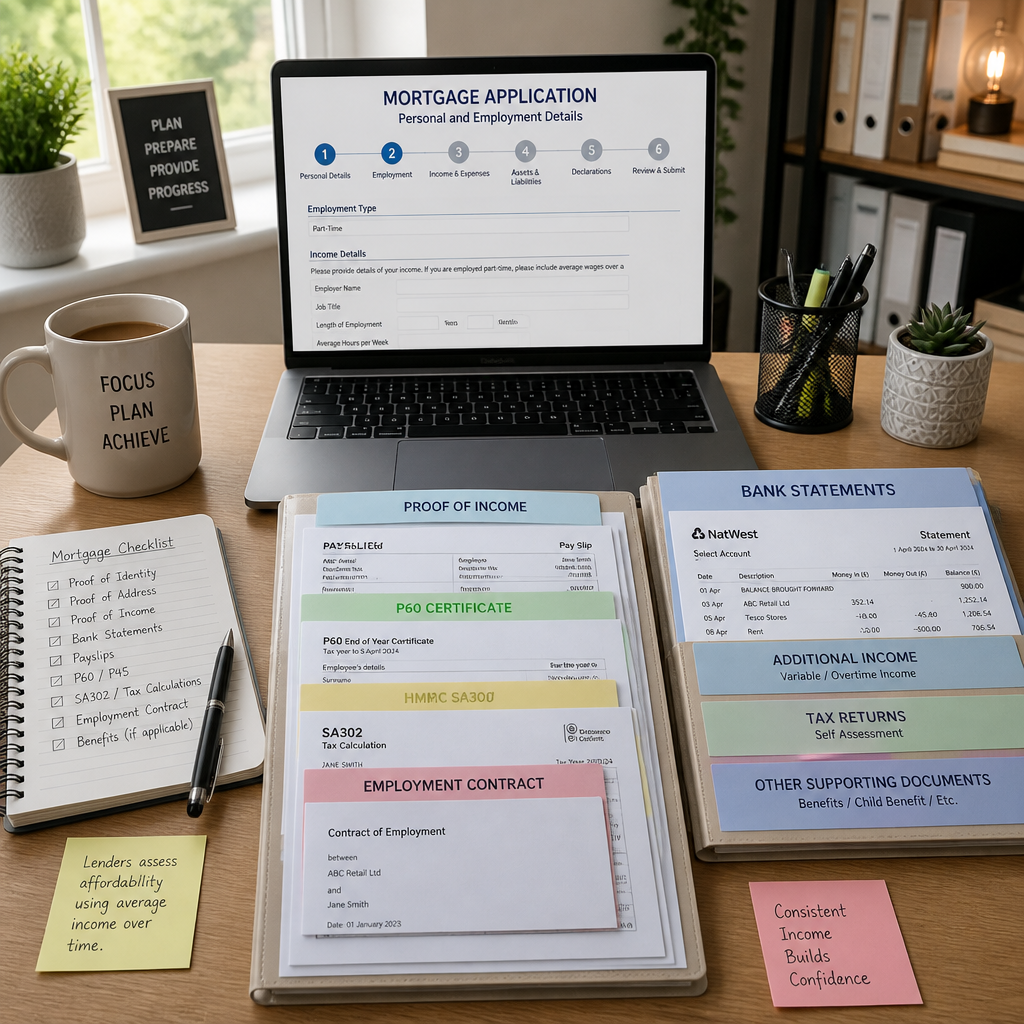
Documentation is where many part-time mortgage applications unravel. The requirements differ depending on whether your hours are fixed or variable, and whether you have a single income source or multiple streams.
Fixed Part-Time Employment
If your contracted hours are stable and consistent, most lenders will require your three most recent payslips plus a corresponding P60 from your most recent tax year. Your employment contract or a letter from your employer confirming the permanent nature of your part-time arrangement strengthens the application significantly. Bank statements covering three to six months are standard, to confirm that the payslip figures match what is actually being received.
Variable or Fluctuating Part-Time Hours
If your hours and income fluctuate, lenders will typically want 12 months of payslips rather than the standard three, and sometimes two to three years of documentation. This allows them to establish an average that they are confident reflects ongoing earnings rather than a one-off good period. Tax returns and bank statements for the equivalent period are common additional requirements.
Self-Employed Part-Time Workers
For those combining part-time employment with any form of self-employment, SA302 tax calculations and tax year overviews from HMRC are the standard evidence. Business accounts prepared by a qualified accountant add further credibility. The most common mistake in this situation is failing to have the most recent Self Assessment return filed before applying. Lenders want confirmed, HMRC-accepted income figures, not estimates.
Pro tip: Request your SA302 documents directly through your HMRC online account before contacting any lender. Having them ready shortens the process considerably and avoids a common delay that can cost you a property under offer.
How Much Can You Borrow on Part-Time Hours?
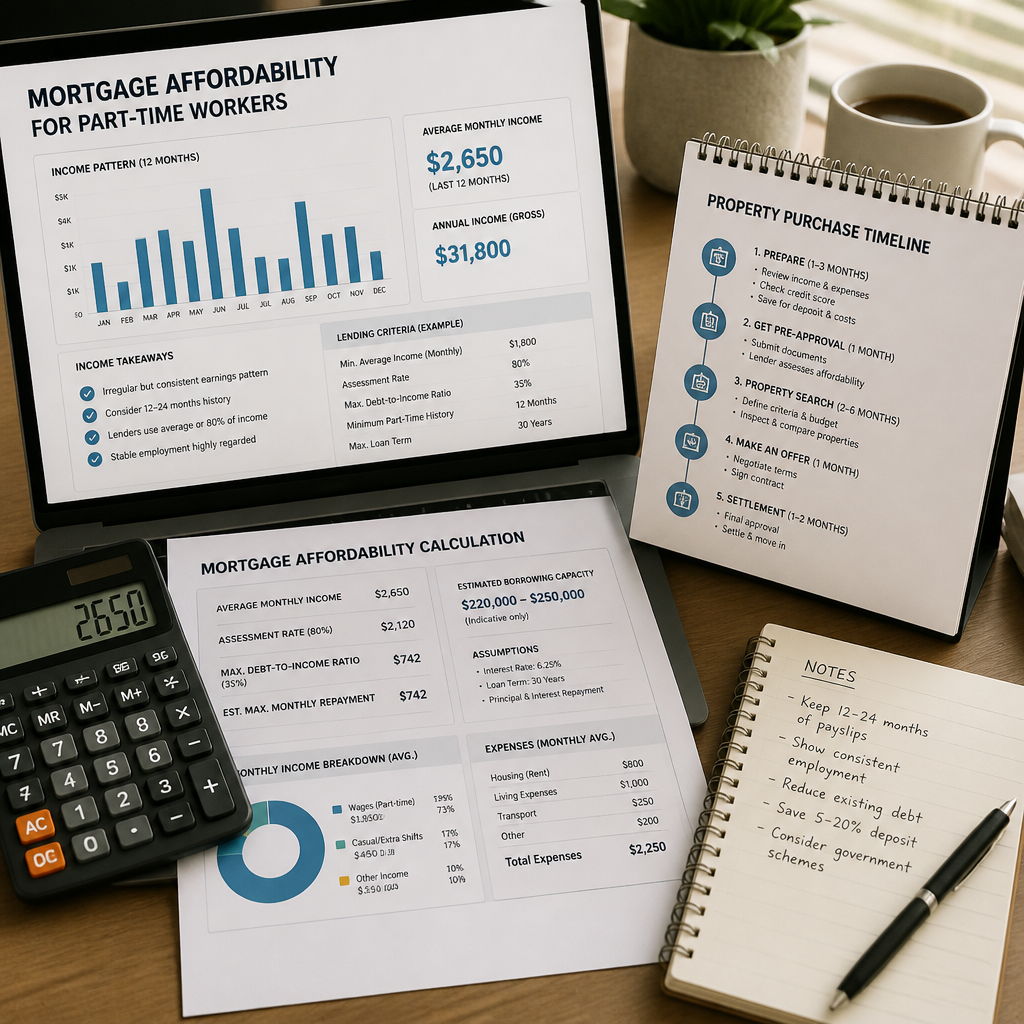
The borrowing limit for a part-time worker follows the same income multiplier logic that applies to any employed applicant. Most lenders will offer between 4 and 4.5 times your annual income. On a part-time salary of £20,000 per year, that translates to a maximum loan of £80,000 to £90,000 at standard multiples.
Several factors influence whether a lender will apply a lower or higher multiplier. Your loan-to-value ratio is one of the most significant. A larger deposit reduces the lender’s risk and can make them more willing to stretch the income multiple. A lower LTV can also unlock better interest rates, which in turn affects monthly affordability. Your credit profile, existing debt commitments, and the overall stability of your income all feed into the same assessment.
For part-time workers applying jointly with a full-time partner, the combined income is assessed together. This frequently resolves the affordability gap that a part-time salary alone might create. The part-time income is not discounted relative to the full-time income in a joint application. Both figures are combined and the multiplier applied to the total.
Specific Scenarios: Reduced Hours, Maternity Leave, and Career Changes
Temporary Reduction vs. Permanent Reduction
This distinction carries significant weight with lenders. If your reduced hours are temporary, for example while you recover from illness or during a fixed-term period, most lenders will still underwrite the application based on your current income rather than your expected future income. Lenders are pricing risk based on what you can afford now, not what you anticipate earning later. A minority of lenders show more flexibility where there is clear documentary evidence of a return to full hours, but it is genuinely the exception.
Reduced Hours Following Maternity or Paternity Leave
Returning from parental leave on reduced hours is one of the most common real-world scenarios Albion Forest advisors encounter. Where you plan to return on part-time hours, lenders will typically assess affordability based on your expected part-time salary, not your pre-leave full-time salary. Being upfront about your plans is essential. Attempting to have a mortgage assessed on a salary you will not actually be earning once the mortgage is live is not a sound strategy, and it can lead to serious problems later. The better approach is to find a lender whose criteria fit your actual future income, with the help of a broker who knows where to look.
Recently Changed Hours on the Same Employer Contract
If you have recently reduced hours with your existing employer, most lenders will work from your new contracted salary. Three months of payslips at the new rate is the standard minimum requirement. A written confirmation from your employer that the change is permanent adds credibility and can make the difference for more cautious lenders.
Comparison: How Different Lender Types Handle Part-Time Income
| Lender Type | Approach to Part-Time Income | Best Suited For |
|---|---|---|
| High Street Banks | Apply standard income multipliers (4 to 4.5x). Accept fixed part-time salaries readily. Variable or fluctuating hours may require more documentation or be declined outright. Criteria tend to be rigid. | Part-time workers with a permanent, fixed contract, clean credit, and a single stable income source. |
| Building Societies | Often more flexible than high-street banks on non-standard employment patterns. More likely to assess applications on a case-by-case basis. Some accept second income streams or variable hours with thorough documentation. | Applicants with fluctuating hours, multiple income sources, or recently reduced hours following parental leave. |
| Specialist Lenders | Widest criteria for complex income profiles. Accept blended income streams (employed plus self-employed), zero-hours patterns with 12 months of evidence, and non-standard arrangements. Rates may be slightly higher to reflect the additional complexity. | Self-employed part-time workers, contractors with mixed income, or applicants who do not fit standard lender criteria. |
In practice, the right lender for your situation depends on the specific combination of your income pattern, credit profile, deposit size, and any secondary income sources. A whole-of-market broker searches across all three categories rather than steering you toward the first lender willing to consider your application.
Common Mistakes Part-Time Applicants Make
The most expensive mistake part-time workers make is going directly to their existing bank before understanding their options. Your bank knows your account, but it does not necessarily have criteria that suit your income profile. A rejection from your bank leaves a footprint on your credit file and narrows your subsequent options.
A second common mistake is failing to account for all eligible income. Many part-time workers underestimate what can be included: a second job, consistent self-employment income, guaranteed shift allowances, or a partner’s income in a joint application. Presenting an incomplete income picture means the affordability calculation comes back lower than it should, sometimes by enough to prevent an approval that would otherwise have been possible.
The third mistake is poor timing around documentation. Self-employed applicants who have not filed their most recent Self Assessment return are in the weakest possible position when they approach a lender. Lenders want HMRC-confirmed figures. Filing your return before applying, rather than after, is not a minor administrative detail. It is often the difference between a completed application and a stalled one.
Pro tip: If your income has grown over the past two years, choose lenders who assess the most recent year alone rather than averaging across two. If your income has dipped recently, the opposite applies. A broker who understands this distinction can save you a significant amount of borrowing capacity.
Frequently Asked Questions
Can I get a mortgage if I only work part-time?
Yes. Working part-time does not prevent you from getting a mortgage in the UK. Lenders assess the income figure you earn, not the hours that produced it. Provided your income is stable, documented, and sufficient to pass the affordability assessment, part-time employment is treated comparably to full-time employment by most mainstream and specialist lenders.
Will lenders treat my part-time salary as less reliable than a full-time salary?
Not automatically. A permanent, fixed part-time contract is generally treated as reliable income. The concern arises with variable or casual part-time work, where hours and earnings shift from month to month. In those cases, lenders take a more conservative view and require more extensive documentation to establish what a reliable average income figure looks like.
How do lenders calculate how much I can borrow on a part-time income?
Most UK lenders apply an income multiplier of 4 to 4.5 times your annual salary to calculate the maximum loan. Some lenders stretch to 5 or 5.5 times for applicants with a lower loan-to-value ratio and strong credit profiles. On a joint application, both incomes are combined before the multiplier is applied. Your existing debts, credit history, and monthly outgoings all factor into the final affordability assessment alongside the income multiplier.
What documents do I need for a part-time mortgage application in the UK?
For fixed part-time employment, most lenders require your three most recent payslips, a P60 from the most recent tax year, and three to six months of bank statements. An employment contract or employer letter confirming the permanent nature of your hours is highly useful. If your hours are variable, expect to provide 12 months of payslips and potentially two years of tax documentation. Self-employed income alongside part-time work requires SA302 tax calculations and tax year overviews, typically for the most recent two years.
I recently dropped to part-time hours. Can I still get a mortgage based on my old full-time salary?
In most cases, no. Lenders underwrite risk based on your current contracted income. They need to be confident you can afford the mortgage on what you earn today, not what you used to earn. There are a small number of lenders who may take a more pragmatic view where there is clear documentary evidence of a planned return to full-time hours, but this is the exception rather than the rule. Applying based on your current part-time income and finding a lender whose criteria fit that figure is the more reliable approach.
Does a larger deposit help if I earn a part-time income?
Yes, meaningfully. A larger deposit reduces your loan-to-value ratio, which reduces lender risk and can open access to higher income multiples and better interest rates. For part-time workers where the income figure is lower, a larger deposit is one of the most effective ways to improve overall affordability and access more competitive products. Even moving from a 10% to a 15% deposit can shift which lenders and rates are available to you.
I am a teacher returning to part-time hours after maternity leave. What should I expect?
Lenders will generally assess affordability based on your expected part-time salary after your return, not your previous full-time pay. The practical approach is to have your employer confirm your new contracted hours and salary in writing, then work with a broker who understands how different lenders treat post-parental-leave income. Some building societies and specialist lenders are significantly more flexible than high street banks in this scenario, and matching your profile to the right lender at the outset avoids unnecessary rejections and credit file enquiries.
Have you recently applied for a mortgage as a part-time worker, or are you planning to? Share what questions or concerns you have run into in your situation and we would be glad to help you think it through.
References
- How lenders assess part-time employment income for UK mortgage applications
- Part-time income mortgage guide: documentation and lender criteria in the UK
- Expert Q&A on reduced-hours mortgages and how lenders treat temporary income drops
- Owning a home on a part-time income: what UK lenders look for
- Part-time mortgage UK: income multipliers, documentation, and joint applications explained