
Almost two in five UK mortgage holders currently have no mortgage protection policy in place, according to research published by MetLife UK in September 2026. That is not a niche problem affecting a small group of risky borrowers. It is a mainstream pattern that leaves millions of homeowners exposed to the single biggest financial risk they face: losing the ability to pay their mortgage after a serious illness, job loss, or death. Mortgage protection insurance UK products exist to close exactly that gap, yet they are still widely misunderstood, under-purchased, and badly matched to individual circumstances. This guide cuts through the confusion.
Table of Contents
- Quick Takeaways
- What Is Mortgage Protection Insurance?
- Types of Mortgage Protection Cover in the UK
- Life Insurance for Mortgage UK: Decreasing vs Level Term
- Critical Illness Cover for Your Mortgage
- Mortgage Payment Protection in 2026: MPPI Explained
- Self-Employed and CIS Contractors: Your Cover Needs Differ
- Comparing Your Main Cover Options
- Do You Legally Have to Have Mortgage Protection Insurance?
- Common Mistakes When Buying Mortgage Protection
- Frequently Asked Questions
- References
Quick Takeaways
| Key Insight | Explanation |
|---|---|
| No legal requirement, but a serious financial risk without it | UK law does not force you to take out mortgage protection insurance, but going without it means your home could be at risk if you cannot work or die during the mortgage term. |
| Decreasing term life insurance suits most repayment mortgages | The payout reduces over time in line with your outstanding balance, making it the most affordable option for capital-and-interest borrowers. |
| Critical illness cover pays out on diagnosis, not just death | Conditions covered by all UK insurers include cancer, heart attack, and stroke. A tax-free lump sum is paid so you can clear or reduce your mortgage while you recover. |
| MPPI covers short-term income loss; income protection covers longer gaps | Mortgage Payment Protection Insurance typically pays for up to 24 months. Income protection can pay until retirement age, making it more suitable for those with no savings buffer. |
| Self-employed and CIS contractors face unique underwriting rules | MPPI exclusions for self-employed people can be restrictive. Income protection written on an “own occupation” basis is often a better fit than standard MPPI for contractors. |
| Buying through your lender is almost always more expensive | Lenders are permitted to sell protection products but they rarely offer whole-of-market comparisons. An independent adviser can access policies across the full market. |
| A combined life and critical illness policy can be cost-effective | Combining both covers under one policy is common in the UK. If you claim for critical illness, the policy pays out and the life cover element ceases, so it is not double-payout cover. |
What Is Mortgage Protection Insurance?
Mortgage protection insurance is an umbrella term for a group of insurance products designed to ensure your mortgage continues to be paid, or is cleared entirely, if something goes wrong with your health, income, or life. It is not a single standardised product. It covers at least three distinct policy types, and confusing one with another is one of the most common and costly mistakes UK borrowers make.
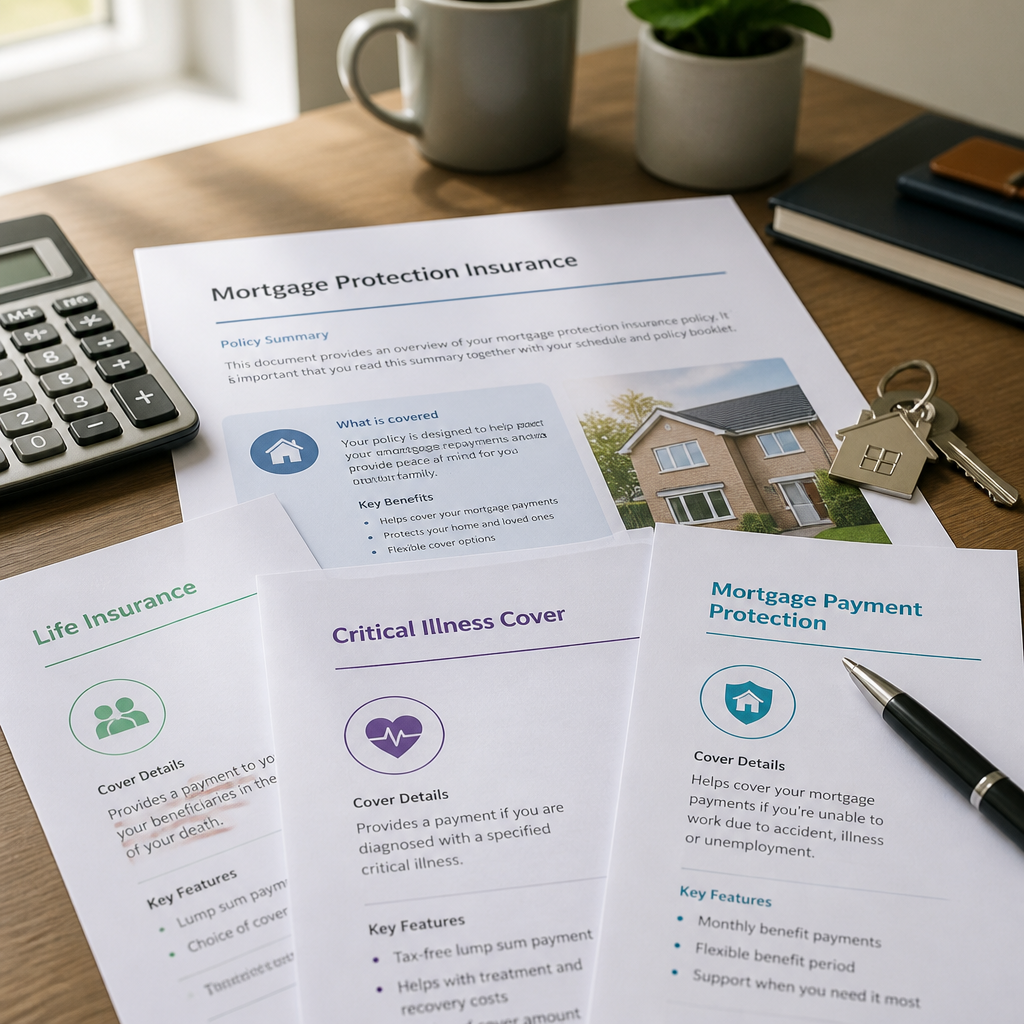
The three main categories are life insurance (also called mortgage life cover), critical illness cover, and Mortgage Payment Protection Insurance (MPPI). Each addresses a different risk. A borrower with all three has comprehensive cover. Most borrowers have none, or at best one that may not match their actual risk profile.
The research is stark. A 2024 FCA Financial Lives survey highlighted by the regulator’s own Protection Market Study found that more than 40% of UK mortgage holders lack life insurance. Separate research by LifeSearch and the HomeOwners Alliance found that over a third (36%) of mortgage holders have no life, income, or critical illness cover of any kind. Almost half of those surveyed said they would struggle to pay their mortgage within six months of losing their income.

Types of Mortgage Protection Cover in the UK
Understanding which product covers which risk is the starting point for making a sensible decision. The three types are not interchangeable, and choosing the wrong one is nearly as expensive as choosing none.
Life Insurance (Mortgage Life Cover)
This pays a lump sum or clears your outstanding mortgage balance if you die during the policy term. It protects your family from inheriting the debt along with the property. It does not pay out if you become too ill to work but remain alive. That is a different product.
Critical Illness Cover
This pays a tax-free lump sum on diagnosis of a specified serious condition. The Association of British Insurers (ABI) sets minimum standards, and all UK insurers must cover at least cancer, heart attack, and stroke. Many policies also cover conditions such as multiple sclerosis, kidney failure, Parkinson’s disease, and major organ transplant. The payout is made on diagnosis, not on recovery or death, which is what makes it genuinely useful: you can use it to reduce or clear your mortgage while you are still alive and dealing with treatment.
Mortgage Payment Protection Insurance (MPPI)
MPPI covers your monthly mortgage payments if you are unable to work due to accident, sickness, or redundancy. It is short-term cover, typically paying out for up to 24 months. It is not income replacement; it is mortgage-specific. Some policies cover all three risks (accident, sickness, and unemployment combined), while cheaper variants cover only one or two of those events.
Pro tip: Do not confuse MPPI with income protection. MPPI covers only your mortgage payment. Income protection covers a percentage of your full salary and can run until retirement age. If your lifestyle costs extend beyond your mortgage, income protection is the stronger product.
Life Insurance for Mortgage UK: Decreasing vs Level Term
When most people think of life insurance for mortgage UK purposes, they are really choosing between two variants of term life insurance. Getting this choice wrong means either overpaying for cover you do not need, or under-insuring and leaving a gap your family cannot bridge.
Decreasing Term Life Insurance
Decreasing term cover is designed specifically for repayment mortgages. The sum assured reduces over the policy term, broadly in line with your declining mortgage balance. Because the insurer’s maximum liability falls each year, the premiums are lower than level term cover for the same starting sum assured. It is the default recommendation for most capital-and-interest borrowers.
Level Term Life Insurance
Level term cover pays a fixed sum regardless of when during the term a claim is made. It is the correct product for interest-only mortgages, where the capital balance does not reduce. It is also useful if you want a lump sum large enough to cover both the mortgage and provide an additional financial cushion for your family. Premiums are slightly higher than decreasing term because the insurer’s liability does not fall over time.
In practice, the right choice depends on your mortgage type first. If you have a repayment mortgage, start with decreasing term. If you have an interest-only mortgage, or if your outstanding balance is likely to stay flat for any reason, level term is the logical fit. A specialist adviser will model both against your actual amortisation schedule rather than guessing.
“Having no life or critical illness insurance in place could result in you and your family losing their home if you die or suffer from a critical illness.” This is not scaremongering. It is the straightforward outcome for households that have not addressed the risk.
Critical Illness Cover for Your Mortgage
Critical illness cover for your mortgage is the most underappreciated protection product in the UK market. Most people acknowledge they need life insurance because death is an obvious risk. Far fewer plan for what happens if they survive a heart attack, cancer diagnosis, or stroke, but are unable to return to work for months or permanently.

The ABI’s minimum standards, last revised in September 2022, define the conditions that every UK critical illness policy must cover and the severity thresholds that must be met for a valid claim. The three universal conditions are cancer, heart attack, and stroke. Additional conditions vary by insurer and may include Parkinson’s disease, kidney failure, multiple sclerosis, and major organ transplant. Before buying, you should check the specific definitions used, not just the list of condition names, because some insurers define conditions more narrowly than others.
How Critical Illness Cover Works With Your Mortgage
The tax-free lump sum paid on diagnosis can be used however you choose. Many borrowers use it to clear or reduce the outstanding mortgage balance. Others use it to cover private medical treatment, lost earnings during recovery, or adaptations to their home. The flexibility is the point: you receive a cash payment and decide what is most urgent.
Combined Life and Critical Illness Policies
The most common way to buy this cover in the UK is as a combined policy with life insurance, known as “life and critical illness cover.” If you claim for a critical illness, the policy pays out and the life cover element ends. This means it is not double coverage; it is either/or. The combined policy is usually more cost-effective than buying separate policies, but it means one claim exhausts all your cover. For borrowers with dependants, a separate critical illness policy on top of life cover gives more comprehensive protection, though at higher cost.
Pro tip: When comparing critical illness policies, pay close attention to the definitions section, not just the list of covered conditions. Two policies may both list “cancer” but define it very differently. A specialist adviser can compare definitions across the market, which a price comparison website cannot do meaningfully.
Mortgage Payment Protection in 2026: MPPI Explained
Mortgage payment protection 2026 products are broadly available for employed workers, the self-employed, and contractors, though the terms and exclusions differ significantly between those groups. MPPI is not life insurance and it is not critical illness cover. It addresses a third scenario: you are alive, you do not have a diagnosed critical illness, but you have lost your income either through redundancy, accident, or illness.
MPPI typically comes in three forms. Accident and sickness only policies cover you if you cannot work due to injury or illness. Unemployment-only policies cover redundancy but not health-related absence. The most comprehensive version covers accident, sickness, and unemployment combined. Premiums reflect the breadth of cover, so the combined policy costs more but provides the most complete short-term safety net.
MPPI Limitations You Should Know
MPPI has a waiting period, typically 30 to 90 days, before payments begin. It usually pays out for a maximum of 12 to 24 months per claim. It is designed as a bridge, not a long-term income replacement. If your recovery or job search takes longer than the policy’s payment window, you face the same shortfall you were trying to avoid. For this reason, many advisers recommend pairing MPPI with a separate income protection policy that activates after the MPPI payments cease.
Self-Employed and CIS Contractors: Your Cover Needs Differ
If you are self-employed or working under the Construction Industry Scheme (CIS), your protection requirements do not follow the same template as a salaried employee. The risks are similar but the products that address them most effectively are different, and the underwriting process reflects this.
MPPI for Self-Employed and Contractors
MPPI is available to self-employed individuals and contractors, but certain exclusions apply that are less common in employed-worker policies. Redundancy cover is often excluded entirely for the self-employed, since the concept of employer-led redundancy does not apply. Accident and sickness cover remains available, but the definition of “unable to work” can be interpreted more restrictively. You need to read the policy wording carefully, not just the headline summary.
Income Protection: The Stronger Option for Contractors
For most CIS contractors and self-employed professionals, a long-term income protection policy written on an “own occupation” basis provides more genuine cover than MPPI. It pays a percentage of your pre-disability income if you cannot perform your specific job, and can be structured to pay until retirement age rather than capping at 24 months. Premiums are assessed based on your occupation, your earnings history, and whether you are employed or self-employed.
CIS contractors in particular often have irregular income patterns, which means the way you calculate your insured income matters. An adviser who understands CIS mortgage underwriting will also understand how to structure protection correctly, using your CIS income evidence in a way that matches your actual earnings rather than defaulting to a figure that underinsures you.
Pro tip: If you already hold a CIS mortgage arranged through a specialist adviser, ask them to review your protection cover at the same time. The income evidence used to qualify you for the mortgage is exactly the evidence needed to underwrite your income protection policy at the correct level.
Comparing Your Main Cover Options
The table below summarises the three main mortgage protection policy types available to UK borrowers in 2026. Each addresses a different risk, and the right answer for most borrowers is a combination of two or three of these, not a single policy.
| Cover Type | What It Covers | Best Suited To |
|---|---|---|
| Decreasing / Level Term Life Insurance | Pays a lump sum on death during the policy term, sized to clear the outstanding mortgage balance. Decreasing term tracks a repayment balance; level term stays fixed. | All mortgage holders with dependants or a partner who co-owns the property. Non-negotiable for anyone with a repayment or interest-only mortgage and financial dependants. |
| Critical Illness Cover | Pays a tax-free lump sum on diagnosis of a specified serious condition (minimum: cancer, heart attack, stroke). Can be used to clear or reduce the mortgage, fund treatment, or cover lost earnings. | Borrowers who want financial protection during serious illness while still alive. Particularly valuable for those without significant savings who could not sustain mortgage payments through a prolonged illness. |
| Mortgage Payment Protection Insurance (MPPI) | Covers monthly mortgage payments for up to 24 months if you cannot work due to accident, sickness, or redundancy. Short-term bridge cover only. | Employed borrowers with limited savings, or those who want a short-term safety net while maintaining other protection. Self-employed applicants should check exclusions carefully before buying. |
Do You Legally Have to Have Mortgage Protection Insurance?
No. UK law does not require you to hold mortgage protection insurance as a condition of having a mortgage. Lenders cannot legally make their mortgage offer conditional on you buying their recommended protection product, though they can and often do offer their own policies at the point of sale.
What lenders can require is buildings insurance, which is a separate product covering the structure of the property. Mortgage protection in the sense of life cover, critical illness cover, or MPPI is always optional from a legal standpoint. That said, “optional” and “unnecessary” are not the same thing. The 36% of UK mortgage holders who have no cover of any kind are taking an unquantified financial risk with their most significant asset.
The practical question is not whether you are legally required to have cover. It is whether your household could sustain its mortgage payments for six, twelve, or twenty-four months without your income, and whether your family could remain in the property if you died with an outstanding mortgage balance. For the vast majority of UK borrowers, the honest answer to both questions is no.
Common Mistakes When Buying Mortgage Protection
The mistakes advisers see repeatedly are predictable and mostly avoidable. Knowing them in advance is more useful than discovering them after a declined claim.
Buying Through the Lender at the Point of Sale
Lenders are permitted to sell protection products, but they are not required to compare the whole market on your behalf. The policy they offer may be adequately priced, or it may be significantly more expensive than equivalent cover available elsewhere. Research consistently suggests that borrowers who arrange protection through a whole-of-market adviser save meaningful amounts over the term of the policy compared to those who take the lender’s in-house product.
Matching Policy Term to Initial Deal Period Rather Than Full Mortgage Term
A common error is to take a five-year protection policy because the initial mortgage rate runs for five years. Your financial exposure exists for the full term of the mortgage, not just the first fixed-rate period. Protection should be structured to match the outstanding mortgage term, not the current deal.
Underinsuring to Keep Premiums Low
Reducing the sum assured to lower the monthly premium is a false economy if the reduced payout does not actually cover the outstanding mortgage balance. The premium saving is small. The shortfall at claim time can be catastrophic. An adviser will model the required sum assured against your actual mortgage balance and structure the policy correctly from day one.
Failing to Review Cover After Life Events
A protection policy bought when you were single with a £150,000 mortgage does not automatically remain adequate after you remortgage to £300,000, have children, or take out additional borrowing. Life events should trigger a protection review, not just a mortgage review.
Frequently Asked Questions
Is mortgage protection insurance the same as life insurance?
Not exactly. Life insurance for mortgage purposes is one type of mortgage protection, but the broader term also includes critical illness cover and Mortgage Payment Protection Insurance (MPPI). Life insurance pays out on death. Critical illness cover pays on diagnosis of a serious condition while you are alive. MPPI covers your monthly payments if you lose your income temporarily. Each addresses a different risk, and most borrowers benefit from more than one type.
How much does mortgage protection insurance cost in the UK?
Premiums vary considerably based on your age, health, smoking status, occupation, the sum assured, and the policy term. Decreasing term life insurance is generally the most affordable option. Premiums for a healthy non-smoker in their thirties covering a typical repayment mortgage can start at a modest monthly amount, but the exact figure depends on individual circumstances. The best way to get an accurate cost is through a whole-of-market adviser rather than a single insurer’s calculator, which by definition only shows you one price.
Can self-employed people get mortgage protection insurance?
Yes. Life insurance, critical illness cover, and MPPI are all available to self-employed individuals and CIS contractors. However, the terms and exclusions can differ significantly from employed-worker policies, particularly for MPPI where redundancy cover is often excluded. Long-term income protection written on an “own occupation” basis is often a more effective solution for self-employed borrowers than MPPI, and it can be structured around your actual earnings as evidenced through your CIS payment records or accounts.
Does mortgage protection insurance pay out for redundancy?
Only if you have a policy that specifically includes unemployment or redundancy cover. Not all mortgage protection products include this. Life insurance and critical illness cover do not cover redundancy at all. MPPI can include redundancy cover, but this is usually only available to employees, not the self-employed. Always check the policy wording rather than the product name to confirm what is and is not covered.
What is the difference between MPPI and income protection insurance?
MPPI is designed to cover only your monthly mortgage payment, typically for a maximum of 12 to 24 months per claim. Income protection replaces a percentage of your full salary and can be structured to pay until retirement age. If your total outgoings exceed your mortgage payment, MPPI alone will not prevent financial difficulty during a prolonged absence from work. Income protection provides broader coverage but generally costs more. For many borrowers, particularly those who are self-employed or have significant household expenses, income protection is the more appropriate product.
Should I buy mortgage protection insurance from my lender or through a broker?
Lenders sell protection products, but they are not whole-of-market advisers. They can only offer you their own products or a limited panel. An independent mortgage protection adviser can access policies from across the market, compare definitions and exclusions (not just headline premiums), and structure cover that genuinely matches your outstanding mortgage term and individual risk profile. For most borrowers, the difference in premium over a full mortgage term is material, and the difference in policy quality can be even more significant.
Do I still need mortgage protection insurance if I have savings?
It depends on the size of your savings relative to your mortgage balance and your monthly outgoings. If your savings could sustain your mortgage payments for 12 months or more and your mortgage balance is modest, you may be comfortable self-insuring for short-term risks. However, life insurance covering the outstanding balance remains relevant regardless of savings level, because the simultaneous loss of income and the need to clear a large debt is a scenario that even substantial savings may not cover. A personalised review will identify where your actual gaps are rather than applying a blanket answer.
If you have recently arranged or are reviewing a mortgage and are uncertain which protection products match your situation, we would welcome your questions or feedback below. What aspect of mortgage protection insurance have you found most confusing in your own experience?
References
- MetLife UK research: two in five UK mortgage holders have no protection policy (Mortgage Solutions, September 2026)
- Association of British Insurers: what critical illness insurance covers and how it works
- HomeOwners Alliance and LifeSearch research: UK mortgage holders without any financial safety net
- MoneySuperMarket: Mortgage Payment Protection Insurance explained, including self-employed eligibility
- Reassured: level term versus decreasing term life insurance compared for UK mortgage holders