
Most people know that overpaying their mortgage saves money. Far fewer know exactly how much they can pay off before they trigger a penalty, whether a lump sum or a regular extra amount is smarter, or whether their spare cash is better off in a savings account altogether. If you have a fixed-rate deal, the answer is not simply “pay as much as you can.” Get it wrong by even £1 over your allowance and you could face a charge worth thousands of pounds. This guide cuts through the confusion around mortgage overpayment UK rules, limits, and the real-world calculation of whether it is genuinely worth doing for your specific situation.
Table of Contents
- Quick Takeaways
- What Is a Mortgage Overpayment?
- The 10% Rule Explained
- Early Repayment Charges: What Happens If You Go Over
- Overpay vs Save vs Invest: Making the Right Call
- Reduce the Term or Reduce Your Monthly Payment?
- Using a Mortgage Overpayment Calculator UK
- Overpayment Strategies for Self-Employed and CIS Contractors
- Overpayment Approaches Compared
- Frequently Asked Questions
- References
Quick Takeaways
| Key Insight | Explanation |
|---|---|
| The standard limit is 10% per year | Most UK lenders allow you to overpay up to 10% of your outstanding mortgage balance each calendar year without an early repayment charge. Exceed it by even £1 and penalties apply. |
| The 10% resets annually, with no rollover | Unused allowance does not carry forward. If you only overpay 5% in year one, you cannot overpay 15% in year two penalty-free. |
| On SVR, the limit usually disappears | Once your fixed or discounted deal ends and you move to your lender’s Standard Variable Rate, overpayments are typically unlimited and penalty-free. |
| Reducing the term saves more than reducing the payment | When you overpay, always instruct your lender to reduce the mortgage term, not your monthly payment. Keeping the payment the same maximises total interest saved. |
| Compare your mortgage rate against your savings rate | If your mortgage interest rate is higher than what your savings account pays (after tax), overpaying is the mathematically superior move. |
| Overpayments reduce your LTV | A lower loan-to-value ratio can unlock better remortgage deals at your next fix. For some borrowers this benefit alone justifies overpaying even when the rate comparison is close. |
| Self-employed and CIS borrowers benefit from early planning | Variable income can make large one-off overpayments tempting in a good year, but check your allowance first and retain a cash buffer before committing. |
What Is a Mortgage Overpayment?
A mortgage overpayment is any payment you make above your contractually required monthly amount. It reduces your outstanding loan balance faster than the scheduled repayment plan would, which in turn reduces the total interest that accrues over the remaining term.
Overpayments come in two forms: regular monthly overpayments, where you increase your standing order by a fixed amount each month, and one-off lump sums, where you make a single larger payment. Both count toward your annual overpayment allowance with most lenders, and both reduce your balance. The key difference is flexibility. Regular overpayments are easier to plan around. Lump sums are powerful if you have received a bonus, an inheritance, or a particularly strong year of self-employed income.
Importantly, once made, a mortgage overpayment is typically irreversible. You cannot withdraw it the way you could money from a savings account. That is why building and maintaining a separate emergency fund before overpaying is not optional advice but a practical necessity.
The 10% Rule Explained
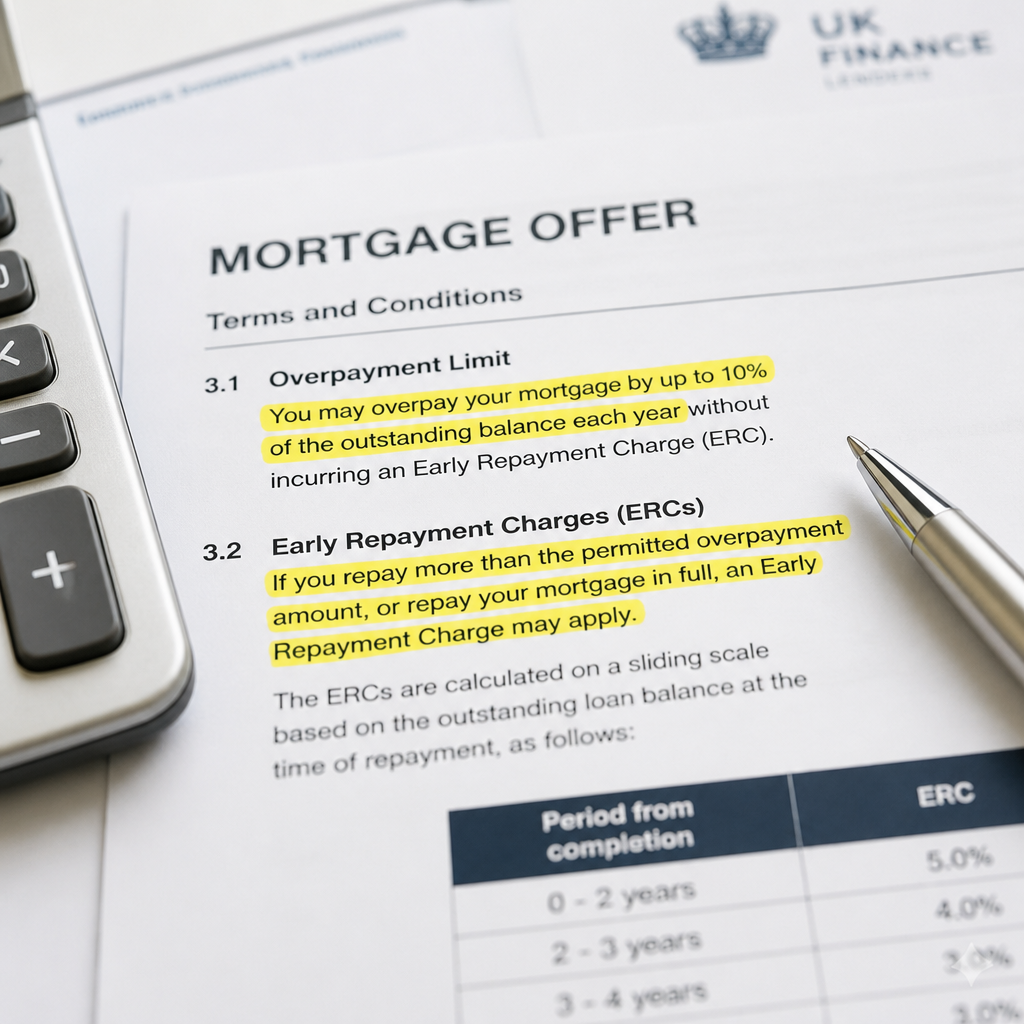
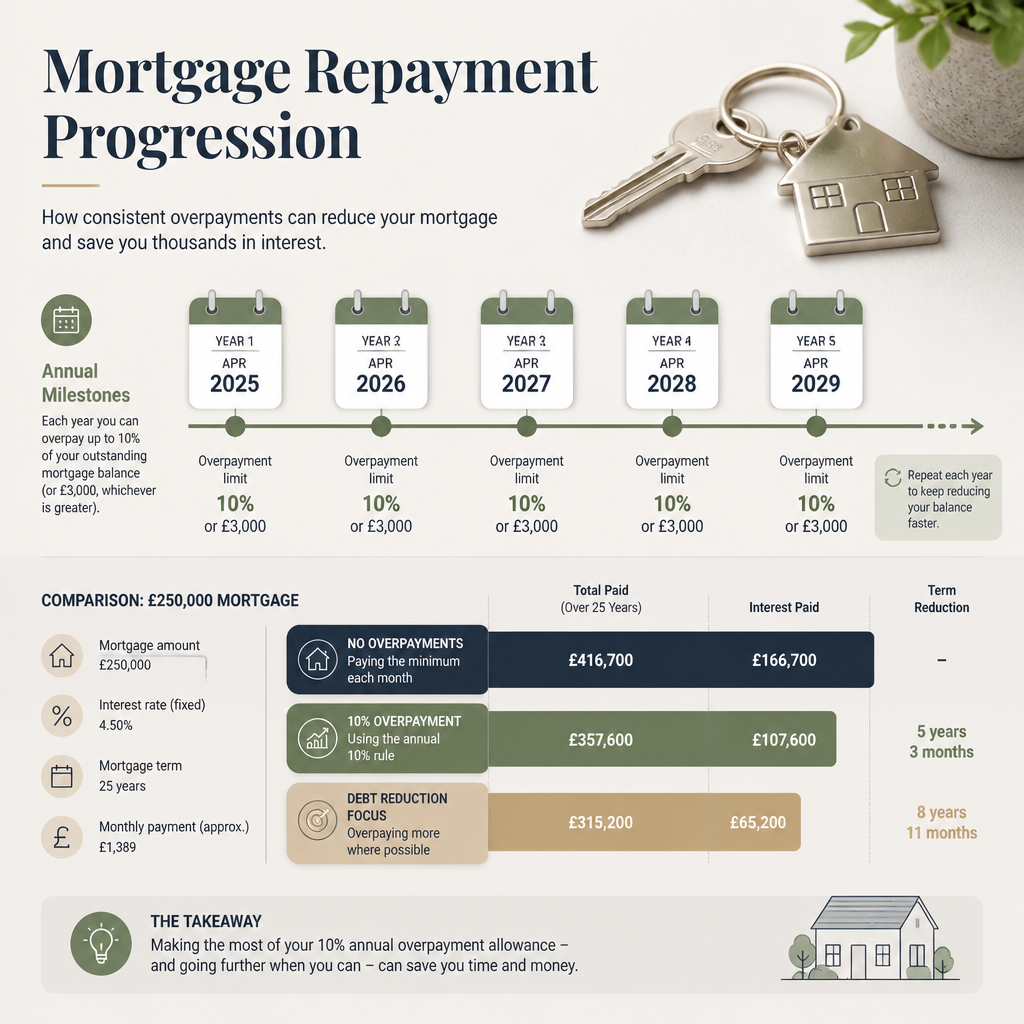
The 10% rule is the standard overpayment cap that most UK mortgage lenders apply during fixed-rate, tracker, and discounted rate deal periods. It means you can overpay up to 10% of your outstanding mortgage balance in a given year without being charged a penalty. On a balance of £250,000, that is up to £25,000 in penalty-free overpayments annually.
How lenders calculate the 10%
Not all lenders calculate the allowance the same way, and this matters. Some base it on the balance outstanding at the start of the year (for example, the balance as of 1 January), while others reset on the anniversary of your mortgage start date. A handful of lenders base the 10% on the original loan amount rather than the current outstanding balance, which is more generous. Check your mortgage offer document or call your lender directly before planning any significant overpayment.
The allowance also resets annually. Any unused portion simply disappears at the reset date. There is no mechanism to roll unused allowance forward, so planning your overpayments around the reset date is worth the effort.
When the 10% limit does not apply
Borrowers on a Standard Variable Rate (SVR) or a lifetime tracker mortgage with no early repayment charge clause can usually overpay without any annual cap. Some lenders, including certain offset mortgage products, also permit unlimited overpayments even during a deal period. Always confirm in writing rather than assuming.
Pro tip: Note your lender’s annual reset date in your calendar. If you are planning a lump sum overpayment near year-end, check whether it falls within this year’s or next year’s allowance. Timing it wrong could push you over the limit even if the total amount is within 10% across both years combined.
Early Repayment Charges: What Happens If You Go Over
An Early Repayment Charge (ERC) is the fee your lender applies when you repay more of your mortgage than your deal terms allow. ERCs exist because when a lender fixes your rate, they typically source funding at a corresponding cost, and early repayment disrupts that arrangement.
ERCs are typically expressed as a percentage of the amount you have overpaid beyond your allowance, or in some cases of the entire outstanding balance, depending on the lender’s terms. The percentage usually steps down over the deal period. A five-year fix might carry a 5% charge in year one, reducing to 4% in year two, down to 1% in year five. The actual rates vary by lender and product, so your mortgage offer document is the only reliable reference point for your specific deal.
These charges can be substantial. On a £200,000 mortgage, even a 2% ERC on the overage amounts to meaningful money. The lesson is straightforward: know your limit before you transfer any extra funds to your mortgage, not after.
Overpaying your mortgage can save you thousands in interest, but go beyond your allowance and you will trigger an early repayment charge. Most UK lenders allow up to 10% of your outstanding balance each year without penalty. Exceed this even by £1 and the charge applies to the excess.
Pro tip: If you want to make a lump sum overpayment that exceeds this year’s remaining allowance, consider splitting it. Pay up to your remaining allowance before the reset date, then pay the rest immediately after. This keeps both payments fully within the penalty-free window.
Overpay vs Save vs Invest: Making the Right Call
This is the question most borrowers get stuck on, and the honest answer is that there is no single universal right answer. There is, however, a clear method for arriving at the right answer for your situation.
The rate comparison rule
The starting point is to compare your mortgage interest rate against the after-tax interest rate your savings would earn. If your mortgage rate is higher than your savings rate after tax, then every pound put into the mortgage saves you more than it would earn in a savings account. Overpaying wins on pure maths.
If your savings rate is meaningfully higher than your mortgage rate, parking the money in a cash ISA or high-interest account can make more financial sense in the short term. The Personal Savings Allowance (£1,000 for basic rate taxpayers, £500 for higher rate taxpayers) and tax-free ISA allowances are relevant here. If you are already exceeding your PSA and paying tax on savings interest, the effective return on savings drops, making the mortgage overpayment more competitive by comparison.
The LTV benefit that many borrowers overlook
There is a second reason to overpay that the pure rate comparison misses: Loan-to-Value improvement. Reducing your outstanding balance faster means that when your current deal ends, you may cross into a lower LTV band, unlocking a cheaper remortgage rate. Over a five-year fix, even modest regular overpayments can shift your LTV from 75% to below 70%, or from 80% to below 75%. Those bands translate into meaningfully lower interest rates with most lenders, and that saving compounds across the next deal period.
Before anything else, keep your emergency fund intact
Overpayments are irreversible. The golden rule, repeated because it is genuinely important, is to ensure you have sufficient liquid savings before committing any extra funds to your mortgage. A common recommendation is three to six months of essential outgoings held in an accessible account. Do not overpay your mortgage at the expense of that buffer.
Reduce the Term or Reduce Your Monthly Payment?
When you make an overpayment, your lender will typically do one of two things with the extra capital: apply it to reduce your remaining mortgage term (keeping your monthly payment the same), or use it to recalculate and reduce your monthly payment (keeping the term the same). Some lenders do the latter automatically without asking you.
Reducing the term generates significantly more total interest savings. This is because the balance is cleared faster, which means less time for interest to accumulate. Reducing the monthly payment does lower your outgoings each month, which can be useful if your circumstances change, but you end up paying more interest overall because the term stays the same length.
The practical action: when making any overpayment, contact your lender and explicitly state that you want the overpayment applied to reduce the term. Do not assume they will do this automatically. Several major lenders default to reducing the monthly payment unless instructed otherwise.
A useful middle ground for borrowers who want flexibility is to keep overpaying each month but allow the lender to reduce the payment. The lower required payment gives you more breathing room in a difficult month, while your actual payments, which you can choose to keep at the higher level, continue reducing the balance faster. This works particularly well for self-employed borrowers whose income fluctuates month to month.
Using a Mortgage Overpayment Calculator UK
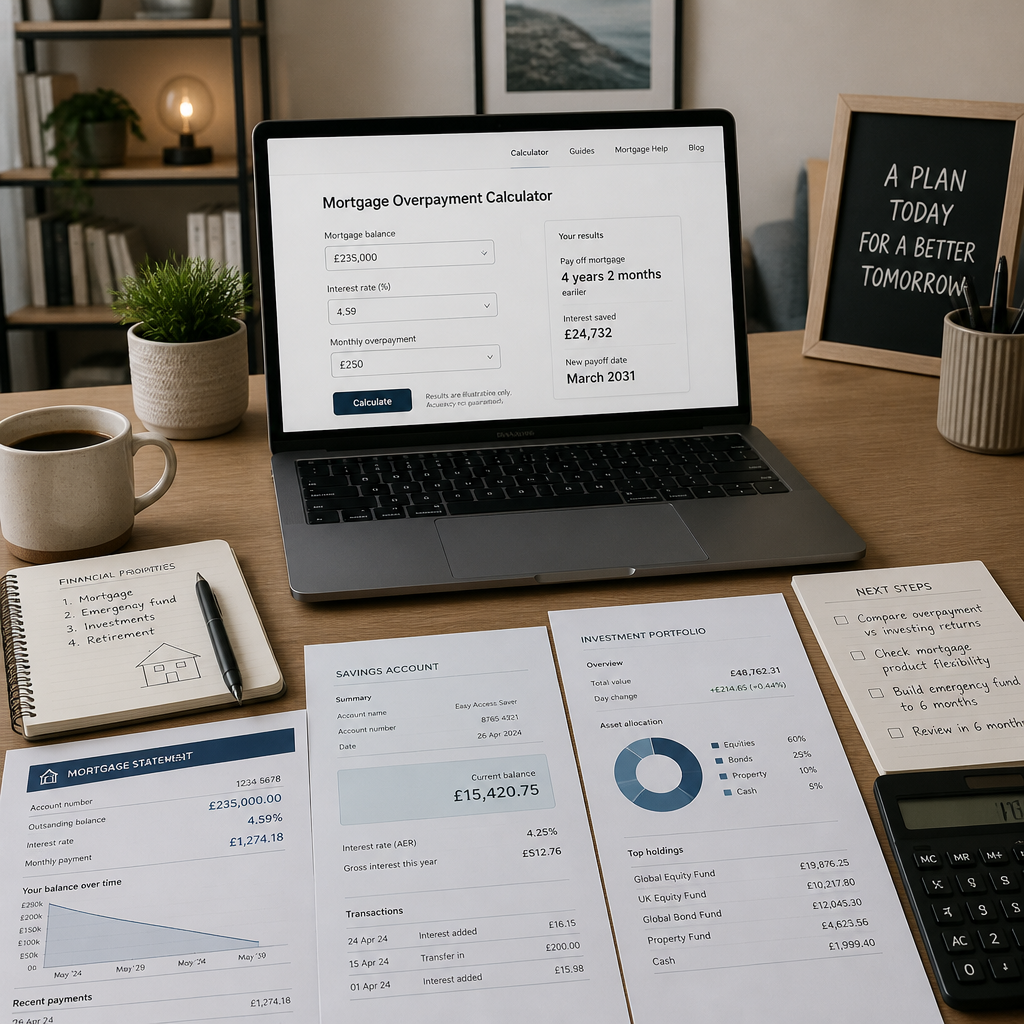
A mortgage overpayment calculator UK is the most direct way to understand what your overpayments will actually achieve. You enter your outstanding balance, remaining term, current interest rate, and the monthly or lump-sum overpayment amount. The tool then shows you the estimated interest saved and the reduction in your mortgage term.
Most major UK lenders publish their own versions, including Nationwide and Santander, and independent calculators are widely available from financial information sites. These tools are illustrative rather than contractually accurate. They assume the current rate stays fixed for the entire term and do not factor in ERCs, which means they are best used for directional comparison rather than precise financial planning.
What to look for in the results
Two numbers matter most: total interest saved and term reduction in years and months. A common pattern for borrowers on a balance of around £200,000 at a rate in the 4-5% range is that a regular monthly overpayment of £200 to £300 saves a meaningful five-figure sum in total interest and reduces the term by several years. The exact numbers depend entirely on your balance, rate, and remaining term, which is why running the calculator with your own figures is far more useful than relying on illustrative examples.
Run the calculation twice: once for a regular monthly overpayment at a modest amount, and once for a single annual lump sum of equivalent total value. The lump sum applied at the start of a year generally produces a slightly better result because it reduces the balance earlier, meaning interest accrues on a lower amount for longer throughout the year.
Pro tip: Use the calculator before you contact your lender, not after. Knowing your projected interest saving puts you in a much stronger position to decide whether the overpayment is the best use of those funds, or whether a combination of partial overpayment and ISA saving makes more sense given current rates.
Overpayment Strategies for Self-Employed and CIS Contractors
For self-employed professionals and CIS mortgage holders, the approach to overpayments needs to account for income variability in a way that salaried borrowers do not have to think about. A strong trading year is an obvious moment to consider a lump-sum overpayment, but the decision is not automatic.
The first consideration is tax timing. Self-employed borrowers often have large tax payments due in January and July through the self-assessment system. Making a significant mortgage overpayment in November without accounting for the January payment on account is a planning error that can create real cash-flow stress. Map out your known liabilities before committing any surplus to the mortgage.
The second consideration is that lenders assessing self-employed income for remortgage applications will look at your most recent two or three years of accounts or tax calculations. Overpaying your mortgage improves your LTV position, which can help at remortgage time. However, it does not alter how your income is assessed. If your income has fluctuated significantly, the key concern at remortgage is income presentation, and that is where specialist advice from a broker familiar with self-employed mortgage applications matters more than any overpayment strategy.
CIS contractors in particular may find that the gross value of their CIS deduction statements can be used by certain lenders to assess income, often producing a more favourable picture than net self-employed accounts. When planning overpayments in a high-income year, factor in whether you are approaching a remortgage and what your LTV position looks like at that point. Crossing into a better LTV band through overpayment can be strategically valuable.
For buy-to-let investors, overpayment rules are identical, but the calculation is slightly different. The interest on a buy-to-let mortgage may be partially tax deductible (depending on your structure and how the tax rules apply to you), which affects the effective cost of that debt. Seek advice on whether overpaying a buy-to-let mortgage or retaining capital for another purchase serves your portfolio goals better.
Overpayment Approaches Compared
| Approach | Best Suited For | Key Consideration |
|---|---|---|
| Regular monthly overpayment (fixed extra amount) | Salaried borrowers or those with stable income who want consistent progress without thinking about it | Set a standing order for the overpayment amount so it is automatic. Choose an amount that leaves comfortable headroom in your budget for variable months. |
| Annual lump sum overpayment | Self-employed borrowers, CIS contractors, or anyone receiving annual bonuses or irregular income | Check your remaining annual allowance before transferring. Time it relative to your lender’s reset date to maximise penalty-free headroom. Retain tax payment reserves first. |
| Offset mortgage overpayment | Borrowers who want the interest benefit of overpaying but need the ability to access funds if their circumstances change | Savings held in the linked account offset the mortgage balance for interest calculation purposes. Useful for self-employed borrowers who need liquidity. Product rates may be higher than standard deals, so the maths needs checking. |
Frequently Asked Questions
How much can I overpay on my mortgage each year without a penalty?
Most UK mortgage lenders allow you to overpay up to 10% of your outstanding balance each year without incurring an Early Repayment Charge. The exact calculation method varies by lender. Some base it on the balance at the start of the calendar year, others on the mortgage anniversary date, and a small number use the original loan amount. Check your mortgage offer document or call your lender to confirm your specific allowance before making any overpayment. Once on a Standard Variable Rate, the limit typically no longer applies.
What happens if I overpay more than the 10% limit?
If you overpay beyond your annual allowance during a fixed-rate or discounted deal period, your lender will apply an Early Repayment Charge to the excess amount. ERCs are typically calculated as a percentage of the overpayment in excess of your allowance, and that percentage usually decreases each year through the deal period. The specific rate is set out in your mortgage offer. In some cases, the ERC applies to your entire outstanding balance rather than just the excess, so always verify your lender’s terms before acting.
Is it better to overpay your mortgage or put money into savings?
The core comparison is between your mortgage interest rate and the after-tax return on savings. If your mortgage rate is higher than what you would earn on savings after tax, overpaying saves you more. If savings rates are meaningfully higher, the maths can favour saving, particularly in a tax-efficient wrapper like a cash ISA. There is also the LTV improvement benefit of overpaying, which can unlock lower remortgage rates at your next deal renewal. For most borrowers on a fixed rate above 4%, and particularly for those approaching an LTV band threshold, overpaying tends to be the better financial move.
Should I reduce my mortgage term or my monthly payment when overpaying?
Reducing the term saves significantly more interest overall. When you instruct your lender to keep your monthly payment the same and apply the overpayment to clearing the balance faster, the mortgage ends sooner and you pay far less in total interest. Many lenders default to reducing your monthly payment unless you specify otherwise, so always contact your lender and confirm in writing that you want the term reduced. The only scenario where reducing the payment makes more practical sense is when you are under genuine cash-flow pressure and need the lower monthly commitment as a safety net.
Can self-employed borrowers benefit from mortgage overpayments?
Yes, and the lump-sum approach often suits self-employed income patterns well. In a strong trading year, a lump-sum overpayment up to your annual allowance can reduce your balance significantly and improve your LTV position ahead of a remortgage. However, self-employed borrowers need to account for tax payment deadlines under self-assessment before committing funds. It is also worth noting that overpaying your mortgage does not affect how a future lender assesses your income for remortgage purposes. That assessment is still based on your accounts or tax returns. For CIS contractors, specialist mortgage advice can make a material difference to both initial mortgage access and remortgage outcomes.
Does overpaying a mortgage affect my credit score?
Overpaying your mortgage does not directly affect your credit score in a negative way. It reduces your outstanding debt, which is generally a positive factor in your credit profile. The main risk to your credit score would arise if you overpaid beyond your ERC limit, triggered a large unexpected charge, and then struggled to meet subsequent payments. Provided you stay within your allowance and maintain all required payments, overpaying poses no credit risk and may modestly improve your credit profile over time by lowering your overall debt level.
Have you started overpaying your mortgage yet, and what prompted you to consider it? We would love to hear what made the biggest difference to your thinking.
References
- UK guide to the 10% mortgage overpayment rule and how lenders calculate your annual allowance
- Overpayment limits and early repayment charges explained for UK mortgage holders
- How UK mortgage overpayments work, including the 10% allowance and when to consider saving instead
- Comparing mortgage overpayments against savings: a UK consumer finance guide
- When and how to overpay your UK mortgage, including penalty rules and LTV considerations