
Being on maternity leave does not close the door on getting a mortgage in the UK. What it does do is add a layer of complexity that catches many applicants off guard, particularly when their bank turns them down based on their current reduced pay rather than their actual salary. If you are currently on maternity leave, planning to go on it soon, or returning to work with a house purchase in mind, the good news is that most mainstream UK lenders will assess a mortgage on maternity leave UK application using your full return-to-work salary, not your statutory maternity pay. But the detail is in how you present your case, what documents you bring to the table, and which lender you approach. Get those three things right and approval is genuinely achievable.
Table of Contents
- How Lenders Assess Income on Maternity Leave
- Quick Takeaways
- What Documents You Need for a Maternity Leave Mortgage Application
- Income Assessment: Maternity Leave Mortgage, the Detail Lenders Focus On
Understanding how the income assessment for a maternity leave mortgage actually works puts you in a much stronger position when negotiating with lenders or choosing which lender to approach. The process is more nuanced than a standard affordability check, and there are several points where the numbers can work in your favour or against you depending on how your application is structured.
How your return-to-work salary is used
When a lender uses your return-to-work salary, they apply their standard income multiplier (typically between 4 and 4.5 times your income) to that salary figure. For example, a contracted salary of £38,000 at a 4.5 multiplier would give a maximum loan of £171,000 on your income alone, before your partner’s income and childcare deductions are applied. Lenders know that your current maternity pay is not representative of what you will actually earn, and they build their long-term calculation around that reality.
What gets stripped from the calculation
Lenders assessing a maternity leave application will generally remove any variable pay elements that depend on you being physically present at work. Bonuses, commission, overtime, and shift allowances are typically excluded unless you have a consistent, provable history and your employer confirms they will continue on your return. This is different from standard applications where such income is often accepted with a two-year track record.
The savings gap requirement
If your confirmed return date is several months away, lenders want reassurance that you can cover the mortgage payments in the interim without going into arrears. In practice, this means showing sufficient savings to bridge that gap. There is no fixed rule on exactly how much is required, but the expectation is that you can demonstrate a credible cash flow plan for the period between application and your first full salary payment after returning.
The key is to show that your long-term income supports the mortgage payments, even if your current income is temporarily reduced. Every lender’s approach to calculating this is different, which is why the right match between applicant and lender matters so much.
Buying a House on Maternity Leave: Timing Your Application
- Self-Employed and CIS Contractors on Maternity Leave
- Lender Approaches Compared
- Childcare Costs and Affordability
- Frequently Asked Questions
- References
How Lenders Assess Income on Maternity Leave
The single most important thing to understand is that lenders assess your long-term affordability, not just your income at the point of application. They know that statutory maternity pay is temporary. They are not looking at your pay slip from last month in isolation. What they are looking at is whether your household can sustainably afford the mortgage once you are back at work.
Most major UK lenders, including the major high street banks, will use your contracted return-to-work salary to calculate how much you can borrow, provided you can demonstrate a confirmed return date and supply a letter from your employer. A smaller group of lenders, mainly smaller building societies, restrict their calculation to your current maternity income only, which can sharply reduce what they will offer you.
This is why the lender you approach matters enormously. Going to the wrong one first, or applying directly to your bank without checking its specific maternity leave criteria, is one of the most common and avoidable mistakes in a maternity leave mortgage application.
Quick Takeaways
| Key Insight | Explanation |
|---|---|
| Most lenders use your return-to-work salary | The majority of mainstream UK lenders will base affordability on your full contracted salary, not your current statutory maternity pay, as long as you have a confirmed return date. |
| An employer letter is non-negotiable | Simply stating you plan to return to work is not enough. Lenders require a signed letter confirming your return date, your contracted salary, and whether you are returning full-time or part-time. |
| Bonuses, overtime, and commission are usually excluded | Lenders assessing a maternity leave mortgage will typically only count your basic salary. Variable pay that depends on being physically at work is stripped from the calculation. |
| Childcare costs reduce your borrowing capacity | Most lenders factor in projected childcare costs when calculating affordability. The higher those costs, the lower your maximum loan. Having a confirmed childcare arrangement with family can remove this deduction entirely. |
| Self-employed applicants face a different set of rules | Self-employed borrowers on maternity leave are typically assessed on Maternity Allowance rather than normal net profit, which significantly affects the mortgage amount available. Specialist lenders exist for this situation. |
| Savings act as a bridging factor | If your return to work is several months away, lenders want to see that you have sufficient savings to cover mortgage payments during that gap period without defaulting. |
| Lender criteria vary widely | No two lenders handle maternity leave applications identically. A rejection from one lender says nothing about your application’s wider viability. A specialist advisor who knows the criteria across the market is essential. |
The gap between what different lenders will offer you on the same income and circumstances is often significant. In practice, we regularly see clients who have been told no by their own bank, then successfully approved at a much higher loan amount through a lender whose criteria specifically accommodates maternity leave income. The key is knowing where to look before you apply.

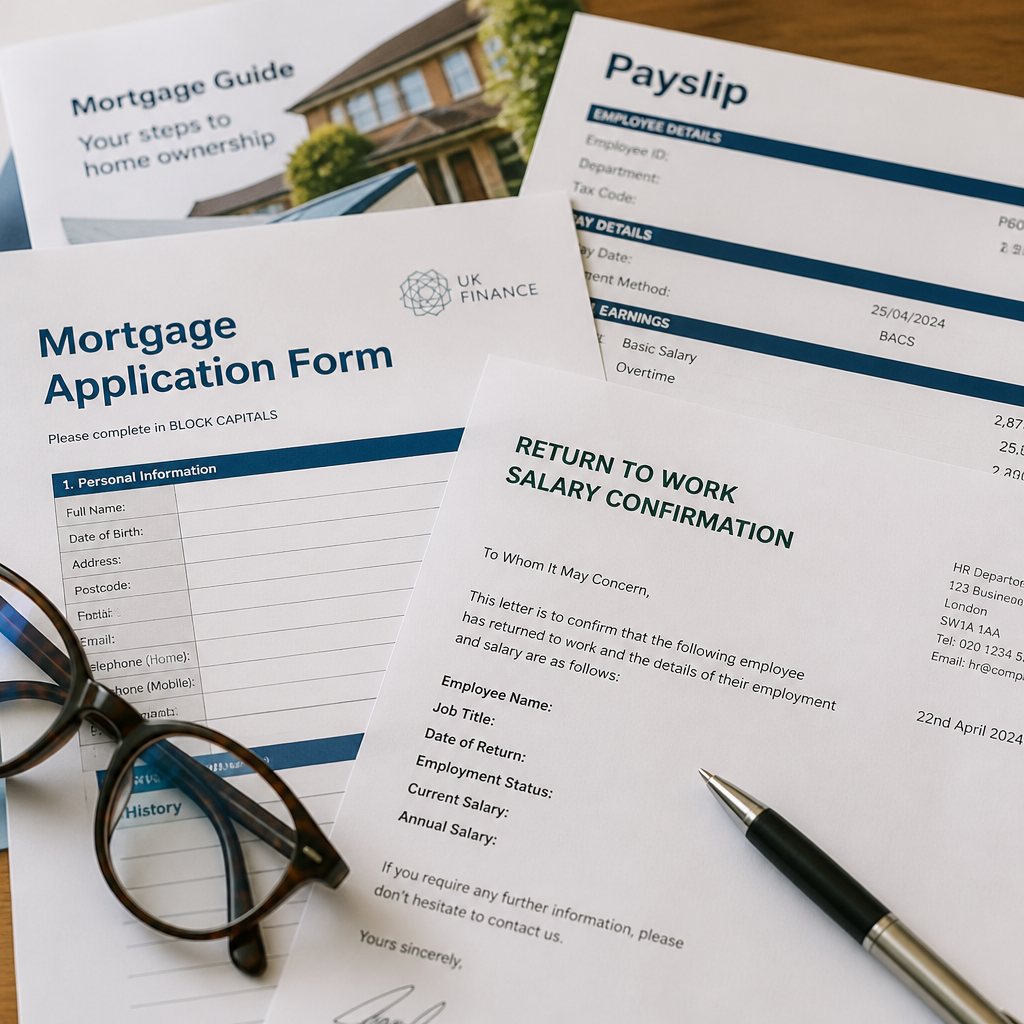
What Documents You Need for a Maternity Leave Mortgage Application
A maternity leave mortgage application involves slightly more paperwork than a standard employed application. This is not because lenders are being obstructive. It is because they need to verify the two incomes that matter: what you earn now, and what you will earn when you return. Having all of this ready before you apply avoids delays and prevents the application from stalling at the underwriting stage.
Essential documents for employed applicants
- An employer letter confirming your return-to-work date, your contracted full-time salary, and whether you are returning on full-time or part-time hours. This is the single most important document in the whole application.
- Recent payslips showing the tapering of your pay, for example the transition from full pay to half pay to statutory maternity pay.
- Your most recent P60, showing the annual income from your last full year of employment.
- Bank statements covering the last three to six months, showing how you are managing your outgoings during the leave period.
- Proof of any savings being used to cover mortgage payments during the leave period.
Additional documentation for joint applications
If you are applying jointly, your partner’s full income documentation will be required in the standard format. Their income is assessed at full value if it is unaffected by the leave period. If your partner has also taken paternity or shared parental leave, lenders apply the same return-to-work logic to their income as well.
Pro tip: Ask your employer to produce the return-to-work letter on headed paper with a signature and a specific date, not just a vague statement of intent. Underwriters will query any letter that lacks a confirmed return date, and this single omission is responsible for more maternity leave mortgage delays than almost anything else.
Income Assessment: Maternity Leave Mortgage, the Detail Lenders Focus On
Understanding how the income assessment for a maternity leave mortgage actually works puts you in a much stronger position when negotiating with lenders or choosing which lender to approach. The process is more nuanced than a standard affordability check, and there are several points where the numbers can work in your favour or against you depending on how your application is structured.
How your return-to-work salary is used
When a lender uses your return-to-work salary, they apply their standard income multiplier (typically between 4 and 4.5 times your income) to that salary figure. For example, a contracted salary of £38,000 at a 4.5 multiplier would give a maximum loan of £171,000 on your income alone, before your partner’s income and childcare deductions are applied. Lenders know that your current maternity pay is not representative of what you will actually earn, and they build their long-term calculation around that reality.
What gets stripped from the calculation
Lenders assessing a maternity leave application will generally remove any variable pay elements that depend on you being physically present at work. Bonuses, commission, overtime, and shift allowances are typically excluded unless you have a consistent, provable history and your employer confirms they will continue on your return. This is different from standard applications where such income is often accepted with a two-year track record.
The savings gap requirement
If your confirmed return date is several months away, lenders want reassurance that you can cover the mortgage payments in the interim without going into arrears. In practice, this means showing sufficient savings to bridge that gap. There is no fixed rule on exactly how much is required, but the expectation is that you can demonstrate a credible cash flow plan for the period between application and your first full salary payment after returning.
The key is to show that your long-term income supports the mortgage payments, even if your current income is temporarily reduced. Every lender’s approach to calculating this is different, which is why the right match between applicant and lender matters so much.
Buying a House on Maternity Leave: Timing Your Application
Buying a house on maternity leave is absolutely possible, and there is no legal barrier to doing so. But timing has a material effect on how smoothly your application runs and which lenders are realistically available to you.
Applying early in your leave
If you are in the early weeks of maternity leave with a clear return date within a few months, lenders are generally comfortable with the application. Your return is close enough that the income bridge is short and manageable. This is typically the smoothest window for a maternity leave mortgage application.
Applying with a distant return date
If you are several months into your leave and not returning for another six months or more, the application becomes more complex. Lenders will scrutinise your savings more carefully and may require stronger evidence of your financial resilience. Some lenders will not proceed if the return date is beyond a certain threshold, making lender selection even more critical at this stage.
Applying while returning part-time
If you plan to return on reduced hours rather than full-time, your affordability calculation will be based on your expected part-time salary, not your previous full-time earnings. You must be clear about this upfront. An employer letter confirming reduced hours and the new salary is essential in this scenario. In practice, many lenders will still proceed, but the loan amount available will reflect the lower income figure going forward.
Pro tip: If you are still pregnant and have not yet started your leave, it can be worth progressing a mortgage application before your leave begins. Your full salary is on your payslips, your affordability assessment is simpler, and you avoid the additional documentation requirements entirely. This is not always practical, but it is worth considering if the timing works.

Self-Employed and CIS Contractors on Maternity Leave
For self-employed borrowers, the maternity leave mortgage process has an additional layer of complexity that standard employed applicants do not face. The core issue is that self-employed people are not entitled to Statutory Maternity Pay. Instead, they may be eligible for Maternity Allowance, which is a separate government benefit paid at a different rate and assessed differently by lenders.
How lenders treat self-employed maternity income
Lenders assess self-employed borrowers using an average of net profit from two to three years of SA302 forms or certified accounts. When maternity leave is declared, the lender may be required to base affordability on Maternity Allowance rather than your usual trading income, which can significantly reduce the mortgage amount available. A sole trader’s net profit and a limited company director’s salary and dividend combination are both affected by this consideration.
In practice, the timing of when you declare your maternity leave relative to your application matters a great deal. Since self-employed income is typically assessed on historic accounts rather than current income, it is possible in some cases that your accounts will not yet reflect any maternity leave period. However, full transparency with your broker is essential. If your income has reduced or is about to reduce due to taking time away from your business, your advisor needs to know so they can match you with lenders whose criteria can accommodate this.
CIS contractors
For CIS (Construction Industry Scheme) contractors, the income assessment during maternity leave follows similar principles to self-employed borrowers, with lenders using your gross CIS income averaged over a qualifying period. The challenge on maternity leave is the same: demonstrating that your reduced period of trading or earnings will recover on your return to work. Specialist CIS mortgage lenders, who are already accustomed to non-standard income, tend to be more flexible in how they approach parental leave scenarios for contractors.
This is an area where working with an advisor who genuinely understands both CIS mortgages and maternity leave applications makes the difference between an approval and an unnecessary rejection.
Lender Approaches Compared
Not all lenders treat a maternity leave mortgage application the same way. The table below illustrates the three broad approaches you will encounter in the UK market, so you know what to expect and where to focus your efforts.
| Lender Approach | How Income is Assessed | What You Need to Provide |
|---|---|---|
| Full return-to-work salary (most mainstream lenders) | Affordability calculated on your contracted salary as if you were already back at work. Most flexible option and typically delivers the highest loan amount. | Employer letter with confirmed return date, recent payslips showing maternity pay, P60, bank statements, savings evidence if return date is distant. |
| Current maternity income only (some smaller building societies) | Affordability calculated only on what you are currently receiving: statutory maternity pay or occupational maternity pay. Significantly restricts how much you can borrow. | Standard income documents only. No employer letter required, but the loan available will be much lower and may not be sufficient for your purchase. |
| Case-by-case specialist assessment | Underwriter reviews all circumstances individually, including savings, partner income, childcare plans, and return timeline. Common with some building societies and specialist lenders. | Full document pack including employer letter, detailed savings statements, partner income evidence, and sometimes a letter from an accountant for self-employed applicants. |
The variation between these three approaches is why a direct application to your existing bank, without checking its specific criteria first, is a real risk. A rejection from a lender using the second approach does not mean you are unapprovable. It means you were matched to the wrong lender. That distinction matters, because multiple rejected applications leave footprints on your credit file.
Childcare Costs and Affordability
One area that surprises many applicants is how much weight lenders give to projected childcare costs. Once you return to work, childcare becomes a regular household expense, and most lenders factor it into their affordability assessment when you are applying on maternity leave.
The practical effect of this is that even if your return-to-work salary qualifies you for a certain loan amount in isolation, childcare costs are deducted before the multiplier is applied, reducing your effective borrowing capacity. For example, if a lender uses an income multiplier of 4.5 and your annual childcare costs are projected at around £9,600, that amount would be subtracted from your salary before the multiplier is applied, meaningfully reducing your maximum loan.
However, if a parent, grandparent, or other family member will be providing childcare at no cost, and you can confirm this credibly, many lenders will remove the childcare deduction from their calculation entirely. This is worth documenting clearly if it applies to your situation, as it can make a substantial difference to the loan amount you are offered.
Buy-to-let applicants on maternity leave are assessed differently, with rental income taking priority in the affordability calculation. In most buy-to-let assessments, personal childcare costs have little or no bearing on the borrowing potential, making buy-to-let applications structurally simpler for borrowers on parental leave who already own a property.
Frequently Asked Questions
Can I get a mortgage while on maternity leave in the UK?
Yes. Most UK lenders will consider a mortgage application from someone on maternity leave. The majority of mainstream lenders will assess affordability based on your contracted return-to-work salary rather than your current statutory maternity pay, provided you can supply a confirmed return date and an employer letter. Being on maternity leave does not make you ineligible, but it does change how your income is assessed and which lenders will work best for your situation.
Which documents do lenders require for a maternity leave mortgage application?
The most important document is an employer letter confirming your return-to-work date, your contracted salary, and whether you are returning full-time or part-time. Beyond that, you will need recent payslips showing your maternity pay, your most recent P60, bank statements from the last three to six months, and evidence of savings if your return date is more than a few months away. Joint applicants will also need full income documentation for their partner.
Do lenders use my maternity pay or my normal salary for affordability?
Most mainstream lenders use your normal contracted salary, not your current maternity pay, when calculating affordability. However, they will only do this if you can demonstrate a confirmed return date backed by an employer letter. A smaller number of lenders, particularly some building societies, base their calculations only on what you are currently receiving, which can significantly limit your borrowing. This variation in lender criteria is one of the strongest reasons to use a specialist mortgage advisor rather than applying directly.
Does maternity leave affect my credit score or mortgage eligibility?
Maternity leave itself does not appear on your credit file and does not directly damage your credit score. However, if reduced income during leave has caused any missed payments or increased use of credit, those events will show on your file and may affect lender decisions. Lenders are also legally required to conduct proper affordability checks and cannot discriminate against you solely because you are on maternity leave, as this would constitute unlawful sex discrimination under the Equality Act 2010.
What if I am self-employed and going on maternity leave?
Self-employed borrowers face a more complex situation because they are not entitled to Statutory Maternity Pay. Instead, they may qualify for Maternity Allowance. Lenders typically assess self-employed income using two to three years of accounts or SA302 forms, and declaring maternity leave may require the lender to base affordability on the lower Maternity Allowance figure rather than your usual net profit. Specialist lenders with flexible criteria for self-employed borrowers exist and are often the right route in this scenario. A broker who understands both self-employed income and maternity leave applications is particularly valuable here.
Can I remortgage while on maternity leave?
Yes, remortgaging while on maternity leave follows the same general principles as a purchase application. Most lenders will use your return-to-work salary for affordability calculations and require the same employer letter. If you are simply switching to a new rate with your existing lender and borrowing the same amount, the process may be simpler since a full affordability reassessment is not always triggered. But if you are looking to borrow more or switch to a new lender, the full maternity leave documentation pack will apply.
Should I wait until I return to work before applying for a mortgage?
Not necessarily. Waiting is sometimes the path of least resistance, but it is not always the right financial decision. Property prices, interest rates, and your personal circumstances may all shift while you wait. Many lenders are perfectly comfortable approving a mortgage application during maternity leave when the documentation is complete and the return-to-work date is confirmed. If you are considering buying a house during your maternity leave, a conversation with a specialist advisor will clarify whether now or later works better for your specific situation.
Have you applied for a mortgage while on maternity leave, or are you currently navigating this process? Share your experience or questions below, we would love to hear what has worked for you.
References
- How lenders calculate affordability and childcare deductions for maternity leave mortgage applicants
- Overview of UK mortgage eligibility rules for applicants on maternity or paternity leave
- Halifax guidance on applying for a mortgage during maternity leave and what evidence is needed
- Q&A on securing a mortgage while on maternity leave, covering income assessment and documentation
- Comparison of UK lender approaches to return-to-work salary versus statutory maternity pay