
If you own rental property in your personal name and pay higher-rate income tax, you are almost certainly paying more tax than you need to. Since Section 24 removed the ability to deduct mortgage interest as an expense, individual landlords are now taxed on turnover, not profit, pushing many into losses on paper while HMRC still sends a bill. A limited company buy to let mortgage UK structure, usually through a Special Purpose Vehicle, fixes that specific problem. But it creates new ones. This guide cuts through the noise and tells you exactly when the SPV route works, when it does not, and what to watch out for before you sign anything.
Table of Contents
- What Is a Limited Company Buy to Let Mortgage?
- What Is an SPV and Why Do Lenders Care?
- The Tax Case for Buying Through a Limited Company
- Real Drawbacks You Need to Price In
The arguments for using an SPV are well publicised. The arguments against receive less coverage, which means many landlords get a nasty surprise after they have already committed. Here is what you actually need to budget for.
Higher Mortgage Rates
Limited company buy to let mortgages typically carry higher interest rates than personal-name equivalents. The gap has narrowed considerably as the market has matured, and pricing now sits within roughly 0.2 to 0.4 percentage points of personal-name products on most competitive products. That sounds small, but on a £250,000 mortgage it adds a meaningful amount annually. Over a 25-year hold, even a modest rate premium accumulates.Running Costs and Compliance
A limited company must file annual accounts at Companies House, submit a Corporation Tax return to HMRC, and file a Confirmation Statement each year. If your company has any complexity, such as multiple properties or shareholders, you will need an accountant. These costs add up. Budget realistically for accountancy fees, Companies House fees, and the additional time spent on compliance. For a single-property landlord, these running costs can easily eliminate the tax saving.Transferring Existing Properties Is Expensive
If you already own buy to let properties in your personal name, transferring them into a new SPV is treated as a disposal for Capital Gains Tax purposes and a purchase for Stamp Duty Land Tax purposes. You are, in effect, selling to yourself. Depending on the value of your portfolio and the gains involved, this can create a very large upfront tax bill. Most landlords in this position find it is cheaper to hold existing properties personally and buy future properties through the company.Fewer Lender Choices Than the Personal Market
While the limited company lender panel has grown, it remains smaller than the personal buy to let market. Some products available to individual borrowers are not offered in a company name. Specialist lenders dominate this space, and their criteria can be more rigorous around personal guarantees and director track records.SPV vs Personal Name vs Trading Company: A Direct Comparison
- Who Should and Who Should Not Use an SPV
- How to Get a Limited Company BTL Mortgage Approved
- Frequently Asked Questions
- References
What Is a Limited Company Buy to Let Mortgage?
Key Insight
| Key Insight | Explanation |
|---|---|
| Section 24 makes personal ownership costly for higher-rate taxpayers | Individual landlords only receive a 20% tax credit on mortgage interest, not a full deduction. Higher and additional rate taxpayers lose significant relief compared to the old system. |
| Corporation Tax rates are lower than higher-rate Income Tax | As of 2025, corporation tax is 19% for profits up to £50,000 and 25% above £250,000, compared to 40% or 45% personal Income Tax for higher earners. |
| Mortgage interest is fully deductible inside an SPV | A limited company can still deduct mortgage interest as a business expense against its profits, restoring the relief that Section 24 removed for individuals. |
| SPV mortgage rates are slightly higher but the gap has narrowed | Lender pricing for limited company buy to let now sits within roughly 0.2 to 0.4 percentage points of personal-name equivalent products on most products. |
| The SPV must have the correct SIC code | Lenders require the company to be registered with SIC codes 68100 or 68209 at Companies House. A general trading company will not qualify with most lenders. |
| Transferring existing properties into a company triggers costs | Moving personally held properties into a new SPV is treated as a sale and purchase for tax purposes, attracting Stamp Duty Land Tax and potential Capital Gains Tax. |
| The structure suits portfolio builders more than single-property landlords | The setup and running costs of a limited company need scale to justify. Landlords with four or more properties tend to benefit most. |
A limited company buy to let mortgage is a mortgage arranged in the name of a company, not an individual. The company borrows the money, the company owns the property, and the company receives the rent. Most commonly, that company is a Special Purpose Vehicle: a limited company created specifically and solely to hold property. The directors are usually the same people who would have bought the property personally, and most lenders require personal guarantees from all directors with a meaningful shareholding.
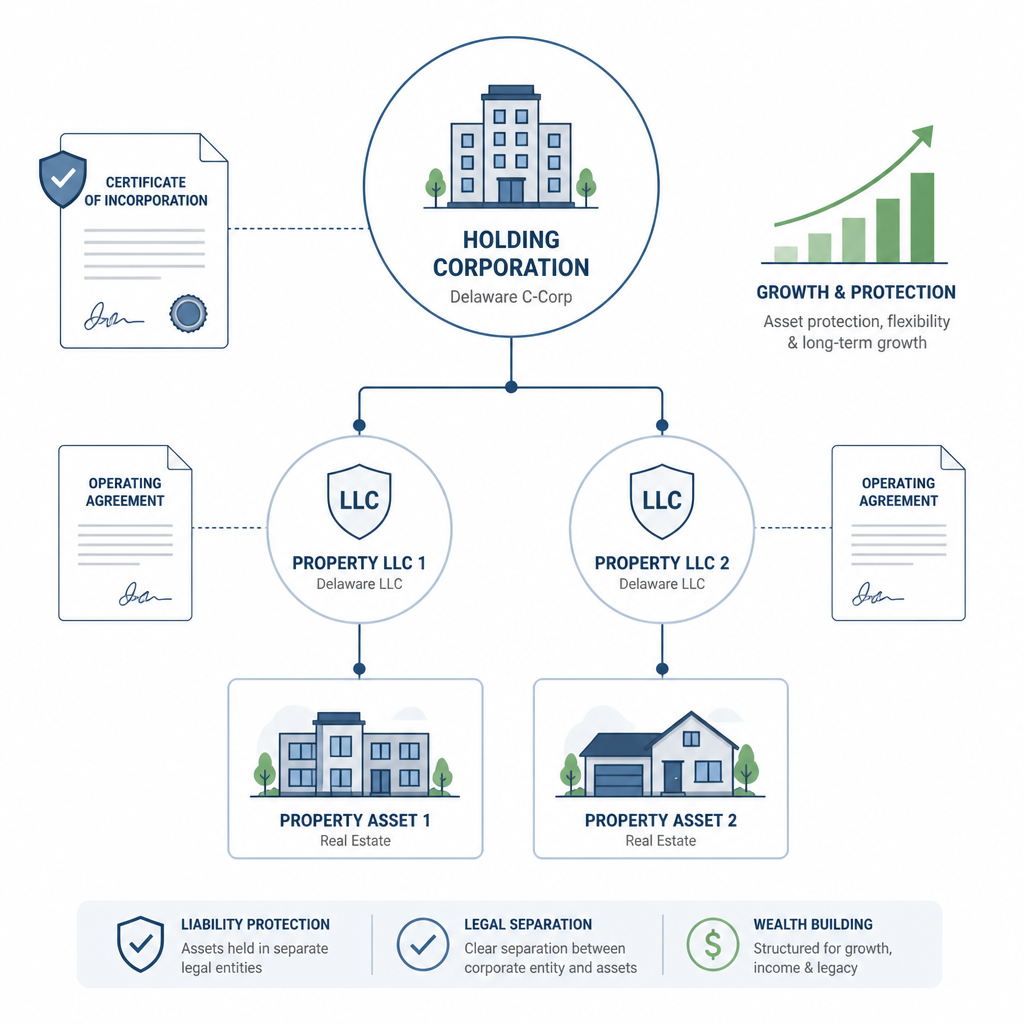

The mechanics are straightforward. You incorporate a company, open a business bank account, and apply for a buy to let mortgage in the company name rather than your own. The lender underwrites the application against the company, the property, and, in most cases, you personally. When rental income arrives, it belongs to the company. You then decide whether to leave those profits inside the company for reinvestment, or extract them as a salary or dividends. That decision is where most of the tax planning sits.
What Is an SPV and Why Do Lenders Care?
SPV stands for Special Purpose Vehicle. In the context of property, it is a limited company with a restricted trading purpose: buying and holding rental property. It does not run any other business. Lenders care about this distinction because a company that trades in multiple sectors creates complexity around income, liabilities, and risk that mortgage underwriters are not set up to assess. An SPV has one job, one income stream, and one type of asset. That makes underwriting far simpler.
To qualify as an SPV with most lenders, the company must be registered at Companies House with an appropriate SIC (Standard Industrial Classification) code. The most widely accepted codes are 68100 (buying and selling of own real estate) and 68209 (other letting of own property). Using the wrong SIC code, or using a general trading company with mixed activities, will result in a straightforward decline from the majority of specialist buy to let lenders.
Pro tip: Register your SPV with SIC code 68209 if your intention is to hold and rent properties rather than trade them. You can register a company for free at Companies House in under 24 hours, but getting the SIC code wrong means going back to change it before any mortgage application goes anywhere.
The lender panel for limited company buy to let has expanded significantly. Specialist lenders such as Kent Reliance, Aldermore, Precise Mortgages, and Paragon now actively compete for this business, and many high-street lenders have entered the market. Deposit requirements are typically between 20% and 35% depending on the property type, lender, and rental yield. The rental income must meet a minimum interest coverage ratio, and lenders assess this against the mortgage interest at a stress-tested rate, not the actual rate you will pay.
The Tax Case for Buying Through a Limited Company
The tax argument for using a limited company is not complicated once you understand what Section 24 actually did. Before 2017, individual landlords could deduct 100% of their mortgage interest from rental income before calculating tax. Section 24 replaced that with a flat 20% tax credit. A basic-rate taxpayer sees little difference. A higher-rate taxpayer loses 20 percentage points of relief. An additional-rate taxpayer loses 25 points.
Inside a limited company, mortgage interest is still treated as a business expense. It is fully deductible from rental profits before corporation tax is calculated. That single change restores the pre-2017 position for the company, and since corporation tax runs at 19% on the first £50,000 of profit, the combined effect can be a significantly lower tax charge on the same rental income.
The tax gap between owning rental property personally and owning it through a company is widening. From April 2027, Income Tax rates on property income for individual landlords are set to rise by a further 2 percentage points, making the limited company route more attractive for higher earners who plan to hold properties for the long term.
The other major tax advantage is profit retention. If you do not need to draw income from the company immediately, profits can stay inside it and be reinvested into the next property purchase. Those retained profits are taxed at corporation tax rates, not at your personal marginal rate. Over a portfolio of several properties, this compounding effect can be substantial. A landlord survey from Paragon Bank conducted in Q4 2024 found that 69% of landlords planning a new buy to let purchase intended to use the limited company route.
Dividend Extraction and the Double Taxation Problem
The tax efficiency of a limited company is real, but it comes with a condition: the benefit largely exists if you leave money inside the company. The moment you extract profits as dividends, you face dividend tax on top of the corporation tax already paid. Dividend tax rates for higher-rate taxpayers mean the combined tax burden on extracted profits can approach, or in some scenarios exceed, the personal Income Tax rate you were trying to avoid.
The practical solution for many landlords is a hybrid approach: take a modest salary up to the personal allowance or National Insurance threshold, top up with dividends within the basic-rate band, and leave the rest inside the company for reinvestment. This requires proper tax planning, and you should not attempt to build this structure without an accountant who specialises in property.

Pro tip: If your goal is to build a multi-property portfolio, the limited company structure is most powerful when you leave profits inside the company and use them to fund future purchases. If you need every penny of rental income to cover personal living costs, the double taxation problem partially erodes the advantage. Model both scenarios with an accountant before you commit to either structure.
Real Drawbacks You Need to Price In
The arguments for using an SPV are well publicised. The arguments against receive less coverage, which means many landlords get a nasty surprise after they have already committed. Here is what you actually need to budget for.
Higher Mortgage Rates
Limited company buy to let mortgages typically carry higher interest rates than personal-name equivalents. The gap has narrowed considerably as the market has matured, and pricing now sits within roughly 0.2 to 0.4 percentage points of personal-name products on most competitive products. That sounds small, but on a £250,000 mortgage it adds a meaningful amount annually. Over a 25-year hold, even a modest rate premium accumulates.
Running Costs and Compliance
A limited company must file annual accounts at Companies House, submit a Corporation Tax return to HMRC, and file a Confirmation Statement each year. If your company has any complexity, such as multiple properties or shareholders, you will need an accountant. These costs add up. Budget realistically for accountancy fees, Companies House fees, and the additional time spent on compliance. For a single-property landlord, these running costs can easily eliminate the tax saving.
Transferring Existing Properties Is Expensive
If you already own buy to let properties in your personal name, transferring them into a new SPV is treated as a disposal for Capital Gains Tax purposes and a purchase for Stamp Duty Land Tax purposes. You are, in effect, selling to yourself. Depending on the value of your portfolio and the gains involved, this can create a very large upfront tax bill. Most landlords in this position find it is cheaper to hold existing properties personally and buy future properties through the company.
Fewer Lender Choices Than the Personal Market
While the limited company lender panel has grown, it remains smaller than the personal buy to let market. Some products available to individual borrowers are not offered in a company name. Specialist lenders dominate this space, and their criteria can be more rigorous around personal guarantees and director track records.
SPV vs Personal Name vs Trading Company: A Direct Comparison
| Factor | Personal Name | SPV Limited Company | General Trading Company |
|---|---|---|---|
| Mortgage interest deduction | 20% tax credit only (Section 24) | Fully deductible as a business expense | Not eligible for standard SPV mortgage products |
| Tax rate on rental profits | 20%, 40%, or 45% Income Tax depending on band | 19% (up to £50k profit) or 25% (above £250k) | Same corporation tax rates, but complex to manage alongside trading income |
| Mortgage rate premium | None (benchmark rate) | Typically 0.2 to 0.4 percentage points above personal rate | Difficult to obtain; most lenders decline non-SPV companies |
| Lender choice | Full market including high street | Good specialist panel; growing mainstream acceptance | Very limited; most lenders require SPV structure |
| Annual compliance costs | Self-assessment tax return | Accounts, Corporation Tax return, Confirmation Statement | Same as SPV, but often more complex |
| Profit retention advantage | None: all income taxed personally | High: profits taxed at corporation tax until withdrawn | Same as SPV, but harder to maintain clean separation |
| Transfer of existing properties | N/A (already personally held) | Triggers CGT and SDLT on transfer | Same as SPV |
Who Should and Who Should Not Use an SPV
The limited company route is not a universal answer. It is a specific tool that works well in specific circumstances. The clearest candidates are higher-rate or additional-rate taxpayers who are building a property portfolio with a long-term plan to retain profits and reinvest. A survey commissioned by Paragon Bank in Q4 2024 found that among landlords with portfolios of four or more properties, 28% already owned through a limited company structure, and 69% planned to use the limited company route on their next purchase. The direction of travel is clear.
Basic-rate taxpayers, on the other hand, gain less from the structure. The Section 24 restriction costs them nothing in real terms because the 20% tax credit equals the 20% basic rate they would pay anyway. For them, the additional complexity, running costs, and marginally higher mortgage rates are unlikely to produce a net saving. The maths needs checking carefully before proceeding.
Landlords Who Are Often Best Served by the SPV Route
Higher-rate and additional-rate taxpayers planning more than one property purchase are the clearest beneficiaries. Self-employed professionals, contractors, and business owners who already operate through a company are also well placed because they understand company structure and often have retained profits available for a deposit. At Albion Forest, we regularly work with self-employed clients and CIS contractors who are expanding their property interests alongside their primary business. The SPV model tends to fit naturally into how they already manage their finances.
Landlords Who Should Pause Before Proceeding
Basic-rate taxpayers with a single property, landlords who need all rental income immediately for personal spending, and anyone with a large existing portfolio held personally should all model their specific numbers before assuming the company route is right. The transfer costs alone can make restructuring economically irrational for established portfolios.
How to Get a Limited Company BTL Mortgage Approved
The application process for a limited company buy to let mortgage is similar to a personal one in terms of what lenders assess, but there are key structural differences in how you prepare.
Setting Up the SPV Correctly
Incorporate the company before you make any mortgage application. Use SIC code 68209 for a rental-focused SPV. Open a dedicated business bank account immediately. Lenders will want to see that the company is set up exclusively for property investment and has no trading history that might cloud the picture. Most lenders are comfortable with a newly incorporated SPV as long as the directors have the right financial background.
What Lenders Assess
Underwriters look at the property’s rental yield against a stressed interest coverage ratio, typically 125% at a stress rate specified by the lender. They will also conduct personal credit checks on the directors and require personal guarantees. Your personal income may be assessed too, depending on the lender’s criteria, particularly for larger loans or portfolio applications.
Pro tip: Because lender criteria for limited company buy to let varies significantly, a whole-of-market broker who specialises in this area is not a nice-to-have, it is genuinely necessary. Criteria differences between lenders on minimum portfolio size, SIC code requirements, personal income thresholds, and stress test rates mean that applying directly or using a generalist broker regularly leads to declines that a specialist would have avoided.
Personal Guarantees and Director Responsibilities
Most lenders require personal guarantees from all directors who hold a significant shareholding. This means the limited liability protection of the company structure does not fully apply to the mortgage debt. If the SPV cannot service the mortgage, the lender can pursue the directors personally. This is standard and expected, but it is important to understand. Structuring the company with multiple shareholders who are not all directors can sometimes help with inheritance planning, but this needs proper legal advice.
At Albion Forest, our advisors work through the complete picture before recommending a structure: tax position, portfolio goals, personal income needs, and exit strategy. A referral introduction is the best way to start that conversation with full context already in place.
Frequently Asked Questions
Can I use my existing trading company to get a buy to let mortgage?
Almost certainly not through mainstream buy to let lenders. Most lenders require the borrowing company to be an SPV, meaning its sole purpose is buying and holding property. A general trading company with multiple business activities will not meet standard SPV mortgage criteria. You would need to set up a separate SPV, which in practice means a new limited company specifically for the property.
Will I pay Stamp Duty if I transfer my personally-held properties into a new SPV?
Yes. A transfer of property from an individual to a limited company, even one you control, is treated as a sale and purchase for Stamp Duty Land Tax purposes. You will also potentially face Capital Gains Tax on any gain between your original purchase price and the current market value at the time of transfer. The combined cost of these charges often makes transferring an existing portfolio into a company financially unattractive. Most landlords in this position buy new properties through the SPV and hold the existing ones personally.
Do limited company buy to let mortgages cost more than personal ones?
Typically yes, but the gap is smaller than it used to be. Pricing for limited company buy to let mortgages now generally sits within 0.2 to 0.4 percentage points of equivalent personal-name products. The wider lender panel that has developed over recent years has driven significant competition. Whether the rate premium is outweighed by the tax saving depends on your specific tax position, and this calculation should be done properly before you commit to either route.
Does an SPV need to have been trading for a minimum period before a lender will consider it?
No. Most specialist buy to let lenders are comfortable lending to a newly incorporated SPV with no trading history, provided the directors meet the lender’s personal credit and income requirements. The company does not need to have been active for any minimum period. What matters to lenders is the directors’ financial strength and the property’s rental coverage, not the company’s age.
Is a limited company buy to let mortgage suitable for a first-time landlord?
It can be, but it is not automatically the right starting point. A first-time landlord who is a basic-rate taxpayer and buying a single property is unlikely to see a material tax benefit from the SPV structure after accounting for the additional complexity and running costs. A higher-rate taxpayer making their first buy to let purchase with a clear intention to grow a portfolio is a much stronger candidate. The decision should be based on your tax position and long-term plans, not on a general assumption that limited company is always better.
What SIC code should my SPV be registered with at Companies House?
For a standard rental property SPV, the most widely accepted SIC code among mortgage lenders is 68209 (other letting of own property and land). SIC code 68100 (buying and selling of own real estate) is also accepted by many lenders and is more appropriate if you intend to buy and sell properties as well as rent them. Using the wrong SIC code or a generic business activity code is one of the most common reasons a limited company buy to let application is declined at the first underwriting check.
If you have used an SPV for a buy to let purchase, or you are weighing up whether the limited company route makes sense for your situation, we would love to hear how you approached the decision.
We would love your feedback and any insights you would share with others. What perspective would you add?
References
- Charcol guide to buy to let through a limited company: tax rules, Section 24, and corporation tax compared
- Pepper Money overview of SPV buy to let mortgages: how they work, SIC codes, and key drawbacks
- TaxD breakdown of the tax benefits of using a buy to let SPV in the UK
- Fox Davidson specialist broker guide to limited company buy to let mortgages and lender criteria
- Landlord Advice UK comparison of individual versus limited company tax structures for buy to let in 2025 to 2026