
If you earn £400, £500, or £600 a day contracting in IT, engineering, finance, or another specialist field, a standard high street mortgage application can feel like a slap in the face. The lender looks at your salary and dividends, ignores the day rate income that actually funds your life, and offers you a mortgage that covers maybe half of what you need. The good news is that the contractor mortgage UK market has matured considerably, and a growing number of lenders now assess affordability the right way: on your day rate. This guide explains exactly how that works, what you need to qualify, and how to avoid the application mistakes that cost contractors money.
Table of Contents
- How Day Rate Assessment Works for Contractor Mortgages
- How Much Can You Borrow on a Day Rate Income?
- IR35 and Your Mortgage: What Lenders Actually Check
- Contract Types Compared: Ltd Company, Umbrella, and CIS
- Documents You Need to Get a Contractor Mortgage Approved
- Common Mistakes Contractors Make When Applying
- IT Contractor Mortgage UK: Sector-Specific Considerations
- Frequently Asked Questions
- References
How Day Rate Assessment Works for Contractor Mortgages
The core issue with standard mortgage underwriting is simple: it is built around employed applicants with a fixed salary. A limited company director who draws £40,000 a year in salary and dividends while billing £180,000 through their company looks, on paper, like a £40,000 earner. Specialist contractor-friendly lenders reject that framing entirely.
Instead, these lenders take your gross day rate and annualise it using a straightforward formula. The most common version is: day rate multiplied by five working days, then multiplied by 46 weeks. The 46-week figure accounts for annual leave and short gaps between contracts. Some lenders use 48 or even 52 weeks, and others apply a further percentage factor on top. The resulting figure is treated as your gross annual income for affordability purposes, regardless of how you actually draw money from your business.
For a £500-per-day contractor, the calculation at 46 weeks produces an assessed income of £115,000. At 48 weeks, it reaches £120,000. That is the income figure used to determine how much you can borrow, and it is entirely separate from what you declared on your last tax return.
The lender you approach is the single biggest factor in how much a day rate contractor can borrow, often the difference between a £200,000 offer and a £500,000-plus offer on exactly the same income.
This is not a loophole. It is how specialist lenders have chosen to recognise contractor income, and it is backed by the logic that a contractor billing at a consistent day rate has demonstrable earning capacity. The key is finding and approaching those lenders correctly, which is exactly where a specialist broker earns their fee.

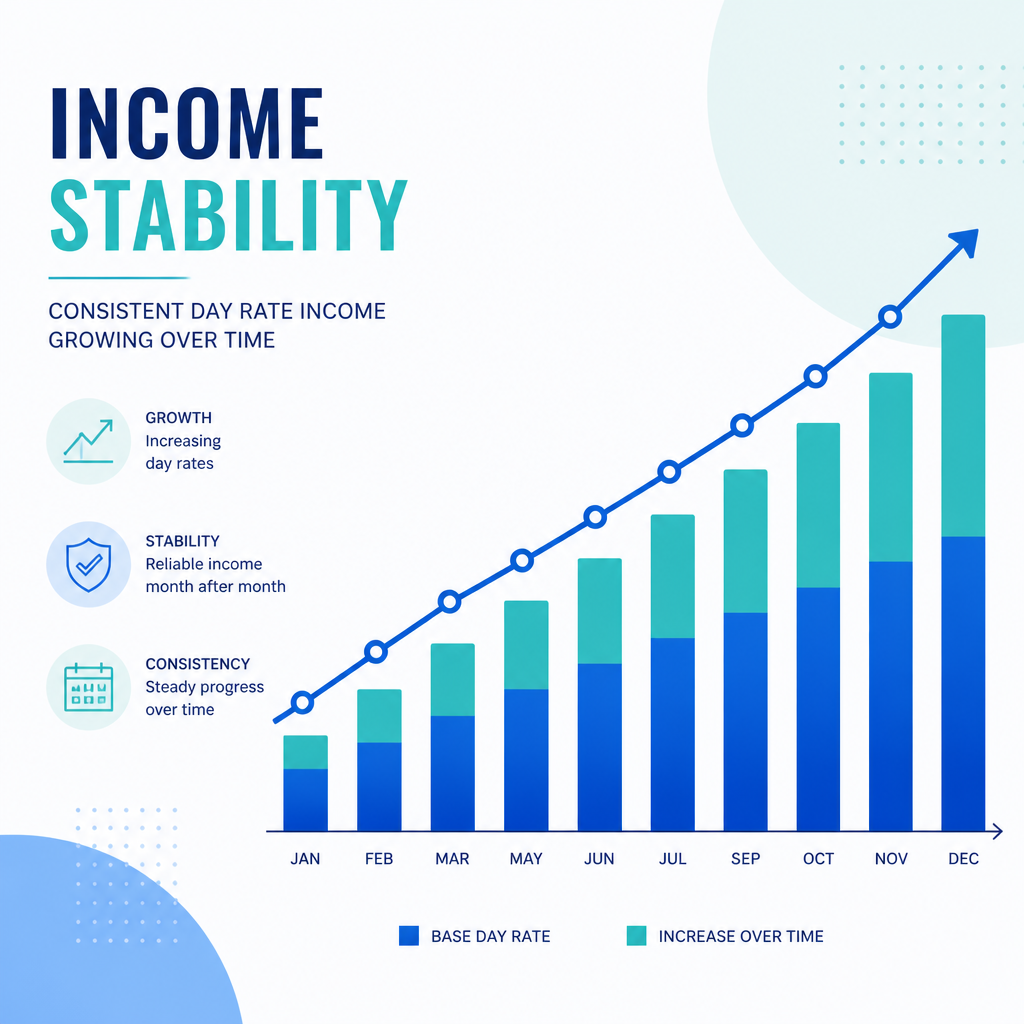
How Much Can You Borrow on a Day Rate Income?
Once a lender has calculated your annualised income from your day rate, they apply an income multiple to arrive at your maximum loan. Most lenders use a standard multiple of 4.5 times income. Some specialist lenders will stretch to 5 times or 5.5 times for contractors with strong profiles.
Day Rate Borrowing Examples
Using a 4.5x multiple and the 46-week formula, here is what different day rates produce in terms of assessed income and approximate maximum borrowing:
- £300/day: assessed income £69,000, maximum borrowing around £310,500
- £400/day: assessed income £92,000, maximum borrowing around £414,000
- £500/day: assessed income £115,000, maximum borrowing around £517,500
- £600/day: assessed income £138,000, maximum borrowing around £621,000
Compare those figures with what the same person would be offered if a lender used their salary and dividends instead of their day rate. A contractor taking home £50,000 in combined salary and dividends would be offered a maximum of roughly £225,000 at 4.5 times. The gap is not marginal. For many contractors, using day rate assessment unlocks 30 to 50 percent more borrowing on identical earnings.
Pro tip: Do not assume all specialist lenders use the same weekly multiplier. The difference between a lender using 46 weeks and one using 52 weeks moves your assessed income by over 13 percent on the same day rate. On a £500-per-day rate, that is roughly £15,000 in additional assessed income and around £67,500 more in borrowing capacity. Ask a broker to run your rate through each lender’s exact criteria before you apply.
Deposit Requirements for Contractor Mortgages
Most contractor-friendly lenders offer products from 10 percent deposit upward, with the most competitive rates available from 25 percent down. A 5 percent deposit is possible but restricts your options significantly, and the rates at that level are rarely worth it if you can stretch further. If your day rate is strong but your deposit is modest, a broker can identify the right lender rather than forcing a choice between a poor rate and a rejected application.
IR35 and Your Mortgage: What Lenders Actually Check
IR35 status is relevant to your mortgage application, but its impact is not always what contractors expect. If you operate outside IR35 through your own limited company, you are in the most lender-friendly position. Lenders can apply day rate annualisation cleanly, and your income calculation is straightforward.
If you are inside IR35, things get more nuanced. Lenders do not all treat inside-IR35 contractors the same way. Some lenders within certain banking groups have updated their policies to welcome contractors operating inside the legislation, assessing income based on gross contract earnings rather than the net pay after employer costs and umbrella fees. Other lenders will try to assess you as a self-employed person and demand two years of accounts, which often does not reflect your real earning position.
Pro tip: If you are inside IR35 and being paid through an umbrella company, gather at least two to three months of payslips before starting your mortgage application. Lenders who understand umbrella income will want to see the gross contract rate confirmed and the deductions accounted for. Payslips alone, without a current contract, will leave underwriters asking questions that slow down or kill your application.
For contractors with mixed IR35 history, where some contracts have been inside and others outside, a specialist broker who can present your income picture coherently is not optional. It is essential.
Contract Types Compared: Ltd Company, Umbrella, and CIS
Different contracting structures are treated differently by lenders, and choosing the wrong lender for your structure is one of the most common reasons contractor mortgage applications fail.
| Contract Structure | How Lenders Calculate Income | Key Considerations |
|---|---|---|
| Limited Company (outside IR35) | Day rate x 5 days x 46-52 weeks. Salary and dividends ignored by specialist lenders. | Most lender-friendly setup. Widest choice of products. Minimum 12 months contracting history typically required. |
| Umbrella Company (inside IR35) | Annualised gross contract rate, with allowance for gaps. Some lenders treat as near-PAYE. | Payslips may show reduced net pay after deductions. Lender choice is narrower but available. Continuity of work matters. |
| CIS (Construction Industry Scheme) | Gross CIS income from payslips or payment statements, annualised over 12 months. | CIS pathway avoids need for two years of accounts. CIS payslips are primary evidence. Strong niche with dedicated lender criteria. |
The CIS pathway deserves particular attention. CIS contractors working in construction and related trades can access specialist mortgage criteria that assesses gross income from CIS payment statements, rather than demanding two years of full accounts. At Albion Forest Mortgages, CIS mortgages are a specific area of expertise, and the criteria involved differ enough from standard contractor mortgages that they warrant separate advice from a broker who knows the relevant lender policies inside out.

Documents You Need to Get a Contractor Mortgage Approved
Getting the documentation right before you apply saves weeks of back-and-forth with lenders. The documents required for a contractor mortgage differ depending on your structure, but the common thread is that lenders want to verify both your current earning capacity and your track record of consistent contracting income.
Core Documents for Limited Company Contractors
- Current contract showing your day rate, contract term, and client details
- Previous contracts showing continuity, typically covering 12 months of working history
- Business bank statements showing turnover consistent with your day rate (usually 3 to 6 months)
- Personal bank statements (3 to 6 months)
- Proof of identity and proof of address
Core Documents for CIS Contractors
- CIS payslips or payment statements covering the last 12 months
- Current contract or working arrangement confirmation
- Bank statements showing CIS income received
- SA302 forms or tax overview (required by some lenders as a secondary check)
A common mistake is submitting accounts when your contract evidence is actually stronger, or sending only a current contract without the bank statements that prove the income has been received consistently. Lenders need both elements: proof of what you earn now and proof that the pattern of earning is established. Gaps between contracts do not automatically disqualify you, but unexplained gaps longer than a few weeks will prompt questions. Brief the broker on any gaps before the application goes in.
Common Mistakes Contractors Make When Applying
The biggest and most expensive mistake is applying directly to a high street lender without checking whether their contractor criteria actually suits your situation. An online affordability calculator will often return a plausible number based on your salary and dividends, and it gives no indication that the underwriter will subsequently decline the case when they see a limited company structure or a contract with two months remaining.
The second most common mistake is timing. Lenders typically want to see at least three to six months remaining on your current contract at the point of application. If your contract is up for renewal in six weeks, applying now and hoping for the best is not a strategy. Either get the renewal confirmed in writing first, or speak to a broker who knows which lenders are comfortable with shorter remaining contract terms.
The third mistake is treating the mortgage application as a solo exercise. Contractor income is complex enough that even experienced brokers at generalist firms sometimes place contractor cases with the wrong lenders. The criteria for contractor affordability is not uniformly published, and the weekly multiplier, minimum day rate, minimum contract history, and acceptable contract types all vary by lender. A broker who deals with contractor mortgages regularly will know where your case fits before they make contact with a lender. That knowledge is not available on a comparison website.
Pro tip: If a friend or colleague recommended Albion Forest Mortgages to you, mention your contracting situation in your initial call. The advice differs substantially depending on whether you are a day rate limited company contractor, a CIS subcontractor, or an umbrella worker, and the right framing from the start avoids wasted time on lenders who would never approve your case.
IT Contractor Mortgage UK: Sector-Specific Considerations
The IT contractor mortgage UK market is one of the most active segments of contractor lending. IT professionals, including software developers, data engineers, cloud architects, business analysts, and project managers, typically operate on day rates that are competitive enough to support substantial mortgage borrowing, but their income structures often make standard mortgage applications unworkable.
IT contractors are frequently outside IR35, operate through limited companies, and move between clients and projects regularly. Those contract gaps and changes of client confuse standard underwriting systems that expect a single employer. A specialist lender assessing an IT contractor on day rate sees a different picture: a professional with demonstrable market value, consistent billing history, and a current contract with a named end client.
Day rates in IT contracting can vary widely based on specialism and experience. What matters for the mortgage is not how high the rate is in isolation but whether you can document it consistently. A contractor with a two-year track record at £400 per day will typically have a smoother application than one billing £700 per day for the first time, even though the second person’s headline numbers look better. Lenders are assessing sustainable, evidenced income, not potential.
IT contractors who have recently moved from permanent employment into contracting should also be aware that some lenders will consider your prior employment in the same field as part of your overall experience. If you spent eight years as a permanent software developer before going independent six months ago, several lenders will treat that track record as meaningful. The right broker will know which lenders take this view and which require a strict 12-month contracting history with no exceptions.
Frequently Asked Questions
Can I get a contractor mortgage with less than 12 months contracting history?
Some lenders will consider applications with less than 12 months of contracting history if you can demonstrate relevant prior employment in the same field. If you transitioned from permanent employment to contracting in the same industry, a number of specialist lenders will treat your employment history as part of the overall picture. However, your choices will be narrower than for a contractor with a full year’s evidence, and you should expect stricter criteria or potentially higher deposit requirements.
Does it matter whether I am inside or outside IR35 for a contractor mortgage?
It matters in terms of which lenders suit you, but it does not close the market to you. Outside IR35 through a limited company is the most straightforward position for day rate annualisation. Inside IR35 via an umbrella narrows your lender options but a number of lenders have updated their policies to accommodate umbrella workers correctly. Being inside IR35 is not a disqualifying factor, but applying to the wrong lender based on your IR35 status will likely result in a decline or an offer based on a fraction of your real income.
Can gaps between contracts affect my contractor mortgage application?
Short gaps between contracts are generally accepted by specialist lenders, which is precisely why most use a 46-week multiplier rather than a full 52 weeks when annualising your day rate. They already account for downtime. What causes problems is a significant recent gap, typically several months or more, with no clear explanation. If you have taken a career break or been between contracts for an extended period, be transparent with your broker so they can match you with a lender whose criteria fits your history, rather than having the gap surface unexpectedly in underwriting.
Do I need an accountant letter for a contractor mortgage?
For limited company contractors applying through the day rate route, an accountant letter is not always required because lenders are assessing your contract rather than your company accounts. Some lenders do request one as a supporting document to confirm trading history or verify that the business is active and in good standing. For contractors applying through a standard self-employed route using accounts and SA302s, an accountant’s involvement in preparing those documents is standard. Your broker will advise what each specific lender expects before you apply.
What is the difference between a contractor mortgage and a CIS mortgage?
Both use specialist income assessment methods that differ from standard self-employed underwriting, but the income evidence differs significantly. A contractor mortgage for a limited company contractor or umbrella worker is typically assessed on a day rate annualisation. A CIS mortgage is assessed on gross income from CIS payment statements, which are the deduction vouchers issued to construction industry subcontractors. CIS contractors do not need two years of full accounts under this route. The key is matching your income structure to the right lending pathway, which is why specialist advice makes a meaningful difference to the outcome.
Can I use a mortgage on day rate income to buy a buy-to-let property?
Yes. Contractor income assessed via day rate annualisation can be used to satisfy the stress testing and minimum income requirements on buy-to-let mortgages, where lenders apply income floors. The rental income from the property does the heavy lifting on affordability in most buy-to-let cases, but personal income thresholds still apply and your contracting income will need to be evidenced in the usual way. A broker who advises both contractors and buy-to-let investors, as Albion Forest Mortgages does, can structure the application to satisfy both elements efficiently.
If you have been through the contractor mortgage process yourself, whether you sailed through it or spent months being declined by the wrong lenders, we would genuinely like to hear what your experience looked like and what made the difference.
We would love your feedback and any insights you would share with others. What perspective would you add?
References
- How day rate annualisation works for UK contractor mortgages and which major lenders use it
- UK lenders that assess contractor income using day rate multiplied by working weeks
- Contractor mortgage guide covering day rate calculation, lender criteria, and income assessment
- Best UK mortgage lenders for day rate and limited company contractors with criteria comparison
- Common contractor mortgage mistakes and how specialist brokers approach complex income cases